Minelab Vanquish
Minelab Vanquish 540 Target ID Chart: Reading The Scale And The Tones
Quick answer
The Vanquish 540 displays conductivity on a segmented discrimination scale rather than a high resolution numeric scale. Iron sits at the bottom, foil and thin gold low, nickels and small rings in the middle, copper and silver at the top. Learn the tones as much as the segments, and record your own readings.
The Minelab Vanquish 540 Pro-Pack was built to be switched on and used, and its target display reflects that. Minelab runs Multi-IQ simultaneous multi frequency underneath, automatically selects settings for the soil, and presents the result on a discrimination scale with tones rather than asking you to interpret a fine grained number. That is a deliberate design decision and it works, provided you learn to read what it does give you.
This page gives the ordering, which is physics and never changes, the bands in terms of position on the scale, and the tone behaviour that experienced Vanquish owners rely on more than the display. It does not give a coin by coin numeric lookup, because the 540 scale is segmented and the segment labelling belongs in your own manual rather than in a figure copied from a forum post.
Top pick
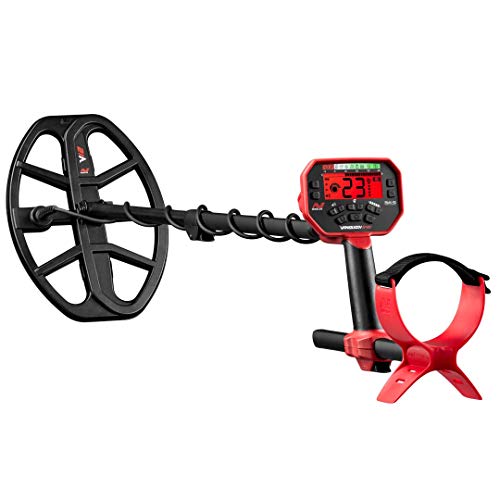
Minelab Vanquish 540 Pro-Pack
The Pro-Pack ships with both the larger V12 coil and the small V8, so the trash separation option is in the box on day one.
Price was accurate when this page was compiled and changes often.
On this page
What does the Vanquish scale show you?
It shows conductivity ordering, displayed as a position on a discrimination scale, with tones layered on top. Low conductive targets sit toward the bottom and produce lower tones. High conductive targets sit toward the top and produce higher tones. Iron announces itself at the very bottom with a low grunt that you will learn faster than you expect.
Because the display is segmented rather than finely numeric, experienced owners lean on the audio. A Vanquish user who can tell a nickel tone from a pull tab tone by ear is faster than one staring at the screen for every signal, and the screen is there to confirm rather than to decide. If you want the finer numeric readout that some detectorists prefer for coin work, that is one of the real differences between this platform and the others, which the Minelab target ID comparison lays out in full.
Vanquish 540 target ordering and tones
Read across: where it sits, what it sounds like, and what it is most often confused with. The last column is deliberately blank for you to fill in from your own ground.
On the Vanquish 540 the conductivity ordering runs iron at the bottom of the scale with a low grunt, foil and thin gold low, nickels and small gold rings in the middle, and copper and silver coins at the top with the highest tones.
| Target | Position on the scale | Typical tone | Confused with | Your reading |
|---|---|---|---|---|
| Nails, small iron, wire | Bottom | Low, broken, often grunting | Nothing you want | Record it |
| Large flat iron, can lids | Can wrap toward the top | High but inconsistent between passes | Silver coins | Record it |
| Foil, thin gold chain | Low | Low | Fine wire, small lead | Record it |
| US nickel, small gold ring | Low to middle | Low to mid | Aluminium screw caps | Record it |
| Pull tabs, aluminium scrap | Middle | Mid | Mid weight gold rings | Record it |
| Zinc cent | Upper middle | Mid to high | Screw caps and washers | Record it |
| Copper cent, clad dime | Upper | High | Heavy aluminium | Record it |
| Clad quarter | Upper | High | Large aluminium | Record it |
| Silver dime, silver quarter | Top | High and clean | Clad coins | Record it |
| Half dollar, silver dollar | Top | High and broad | Flat iron, can lids | Record it |
Positions rather than numbers. The Vanquish presents a segmented discrimination scale, and the segment count and labelling for your model belong in the Vanquish instruction manual display chapter. Count the segments on your own display and write down where each reference coin lands, because that is the only version of this chart that is definitely correct for your machine.
Why does Minelab give this machine a coarser scale?
Because of what the Vanquish is for. Minelab positions it as a turn on and go machine that auto selects settings by soil so the user does not have to choose frequencies or ground balance. A very fine numeric scale is only useful to somebody prepared to memorise it, and the audience for this machine is better served by clear tones, clean separation and a display that does not invite over analysis.
That is not a criticism. Plenty of experienced detectorists keep a Vanquish as a second machine precisely because it is quick to deploy and hard to mis set. It does mean that if your hunting depends on splitting hairs between two adjacent conductivity values, for example chasing specific coin types in heavy clad trash, the higher resolution machines earn their extra cost. For everything else the ordering here is all you need, and the site by site settings guide covers getting the most from the modes.
What moves the reading on a Vanquish?
The same conditions that move every machine, in roughly this order of importance.
Depth, iron alongside the target, corrosion, orientation and coil choice all shift where a target lands on the Vanquish scale, and together they move it further than the width of any single band.
| Condition | Effect on the reading | What to do |
|---|---|---|
| Depth | Reading drops and becomes unstable before the signal fades | Average several sweeps rather than trusting one |
| Iron beside the target | Pulls the response down and breaks the tone up | Fit the smaller coil and sweep from several directions |
| Corroded or worn target | Reads lower and broader than a clean example | Expect old coins to sit below your clean reference coin |
| Target on edge | Reads low and small | Cross the target at ninety degrees before deciding |
| Coil size | The larger coil blurs close targets, the small one separates them | Match the coil to trash density, not to field size |
| Wet salt sand | Compresses and scatters readings | Use the beach configuration and slow down |
| Iron bias setting | Changes how readily doubtful targets are called ferrous | Adjust in single steps, then dig ten targets before judging |
Minelab lists iron bias control and ten volume settings among the 540 audio controls, both of which change how confident the machine sounds about a marginal target.
What to add to a Vanquish 540
The Pro-Pack already includes two coils and wireless headphones, so the gaps are elsewhere.

Minelab PRO-FIND 35
$99.00Minelab lists it as waterproof to 10 feet with ferrous tone ID and five sensitivity levels, and it is the accessory that most shortens a beginner learning curve.
Best for: anyone digging without a pinpointer
Check price on Amazon
Minelab PRO-FIND 15
$69.00Waterproof to 5 feet per Minelab with audio indication only, which is the cheapest way to stop digging blind.
Best for: a first pinpointer on a strict budget
Check price on Amazon Minelab Vanquish 540 Pro-Pack
$399.00Ships as a Pro-Pack with both coils and Bluetooth wireless headphones, which is most of the usual first year shopping list in one box.
Best for: a beginner who does not want to buy twice
Check price on AmazonHow we chose
We did not test these machines in person and we publish no find claims. Picks are researched from manufacturer specifications and owner manuals, published listing features, waterproof ratings and warranty terms, and the recurring themes in verified owner reviews. We favour the established detector brands because coils, shafts and control boxes have to stay available years after a model is discontinued, and we place every pick in the tier where its price and capability honestly belong.
Sources
- Minelab Vanquish series instruction manual, display and discrimination chapters
- Minelab Vanquish 540 published product specification sheet
- Manufacturer listing specifications for the Vanquish 540 Pro-Pack, PRO-FIND 35 and PRO-FIND 15
Frequently asked questions
Does the Vanquish 540 have a numeric target ID?
It presents conductivity on a segmented discrimination scale with tones, rather than the high resolution numeric readout of the Equinox 700 and 900 or the Manticore. Check your own manual display chapter for exactly what your unit shows and how many segments it has, then record where your reference coins land. Relying on the tones is what most experienced Vanquish owners end up doing anyway.
Can I use Equinox target ID numbers on a Vanquish?
No, and it is the most common mistake people make when moving between Minelab machines. The ordering of targets is identical because conductivity ordering is physics, but the scales are different and numbers do not convert reliably between them. Learn the ordering, then calibrate the machine in front of you with buried reference targets in your own soil.
Which coil should I use in a trashy park?
The smaller one that ships with the Pro-Pack. A large coil covers more ground per sweep but merges targets that sit close together, which is exactly the problem in a park full of pull tabs and bottle caps. The small coil is slower to cover ground and much better at telling you there are two objects under it rather than one.
Is iron bias worth adjusting?
Yes, carefully and in single steps. Minelab lists iron bias control among the 540 audio features, and it governs how readily the machine calls a doubtful response ferrous. Raise it if you are digging too much flat rusty iron that reads high. Lower it if you suspect good targets beside iron are being hidden. Dig ten targets after each change before you judge.
Does the Vanquish need ground balancing?
Minelab describes the Vanquish as auto selecting settings for the soil so the user does not have to choose frequencies or ground balance, which is the point of the machine. If it becomes unstable, the useful responses are to switch to the configuration built for the ground, reduce coverage speed, check for electrical interference nearby, and accept lower sensitivity on wet salt sand.
Researched, not professional advice. This page is compiled from published specifications, manuals and owner-review consensus, not hands-on testing. Target ID numbers, depth figures and settings vary with soil chemistry, moisture, target size, depth, orientation and firmware version, so treat every figure here as a starting point and verify it against your own machine's manual and your own ground. As an Amazon Associate we earn from qualifying purchases.