Cross-machine master charts
Metal Detector Target ID Chart: What Every Number on the 0 to 99 Scale Means
Quick answer
A target ID is a conductivity number, on most modern machines a 0 to 99 scale. Iron sits at the bottom, foil and small gold between about 2 and 12, a US nickel near 12 to 13, pull tabs 9 to 20, zinc and copper cents 20 to 28, and silver coins 25 to 40. Soil, depth and corrosion shift every one of those bands.
Target ID is a conductivity ordering, not a lookup table. The machine measures how readily a buried object carries an induced current, converts that to a number, and prints it. The ordering is physics and it holds on every machine ever built: iron at the bottom, thin aluminium and small gold low, nickel and pull tabs in the middle, copper and silver at the top. The exact number is not physics. It belongs to one machine, one mode, one firmware version and one patch of ground.
So read the bands below as neighbourhoods rather than addresses. The value of a chart like this is that it tells you what else lives in the band you just heard, which is the only question that matters when you are deciding whether to cut turf. If you want the numbers for one specific machine, the Equinox 900 target ID chart and the Equinox 700 chart narrow it down a long way.
Top pick
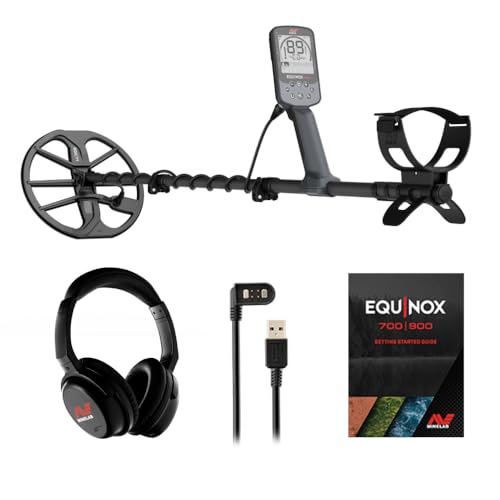
Minelab Equinox 900
Minelab publishes 119 high-resolution target IDs on the 900, which is the finest ID resolution in the catalog outside the Manticore.
Price was accurate when this page was compiled and changes often.
On this page
What does each number on the target ID scale actually mean?
The bands below assume a 0 to 99 non-ferrous scale, a coin-sized target at normal hunting depth, and reasonably neutral soil. They are the bands that owners consistently report and that the manuals sketch in their discrimination diagrams. They are not measurements taken from any one machine.
On a 0 to 99 scale, foil and small gold cluster between 2 and 12, a US nickel lands near 12 to 13, pull tabs cover 9 to 20, and silver coins run from about 25 to 40.
| Target | Typical ID band | Shares the band with | Why it reads there |
|---|---|---|---|
| Iron nail, bottle cap, rust | Below 0 to about 10, unstable | Nothing you want, but caps mimic coins | Ferrous response, often negative or wildly jumpy |
| Thin aluminium foil | 2 to 8 | Small gold chain, earring backs | Very low conductor, small mass |
| Small gold jewellery | 2 to 12 | Foil, small tabs | Gold is a poor conductor for its value, and small items read lower still |
| Lead fishing weight | 8 to 20 | Pull tabs, small gold | Lead is a low conductor regardless of size |
| US nickel (five cents) | 12 to 13 | Beaver-tail pull tabs | Cupronickel alloy sits in a narrow, reliable slot |
| Beaver-tail pull tab | 9 to 16 | Nickels, small gold rings | The single most dug piece of trash in North America |
| Square pull tab | 17 to 20 | Zinc cents, mid-size gold rings | More aluminium mass than a beaver tail |
| Gold ring, mid to large | 12 to 25 | Pull tabs, screw caps, zinc cents | Ring size moves the number more than purity does |
| Zinc (post-1982) US cent | 20 to 24 | Square tabs, screw caps | Zinc core, thin copper plating |
| Aluminium screw cap | 22 to 30 | Zinc and copper cents, dimes | The classic false dig on old picnic ground |
| Copper US cent, Indian head | 24 to 28 | Silver dimes | High conductor, small diameter |
| Silver dime | 25 to 29 | Copper cents | High conductor, but small, so it reads below a quarter |
| Clad US quarter | 28 to 31 | Silver quarters, large tabs | Conductivity plus diameter both push it up |
| Silver quarter | 30 to 33 | Clad quarters | Silver reads a touch above clad at the same diameter |
| Silver half dollar | 32 to 36 | Large copper, flat can slaw | More mass, higher number |
| Silver dollar, large silver | 36 to 40 and up | Big flat aluminium | The top of the usable non-ferrous range |
Bands are the ranges owners consistently report on 0 to 99 machines. Soil chemistry, moisture, depth, target orientation, corrosion and firmware all shift them. A coin standing on edge can read 10 points low or vanish entirely.
Why does the same coin read differently on two machines?
Because the scale is a manufacturer decision, not a standard. Every machine in this catalog that prints a number prints it on its own scale, and the top end is where they diverge most. Garrett lists a 0 to 99 Digital Target ID, Fisher F22 lists a 0 to 99 numeric Target-ID with a four-tone audio system, Bounty Hunter Land Ranger Pro advertises 99 points of target ID resolution, and Nokta The Legend 2 lists 99 target IDs with harmonic tones. Those are four different 99-point scales, and a silver quarter does not land on the same number on all four.
Minelab splits further. The Minelab Equinox 900 carries what Minelab calls 119 high-resolution target IDs, which puts ferrous targets below zero rather than crowding them into the bottom of a 0 to 99 range. The Minelab Manticore adds a two-dimensional target display, so the number is only half the information it gives you. Read the frequency chart next, because operating frequency shifts where the low-conductor targets land more than any other setting.
How do the scales compare across brands?
This is the part most charts get wrong by implying one number fits all. Here is what each maker publishes about its own scale.
Four brands in this catalog all advertise a 99-point scale, and Minelab alone publishes 119 IDs on the Equinox 700 and 900, which is why cross-brand ID charts mislead.
| Machine family | What the maker publishes | Ferrous end | Practical effect |
|---|---|---|---|
| Minelab Equinox 900 | 119 high-resolution target IDs | Reads below zero | Finer separation between adjacent non-ferrous targets |
| Minelab Equinox 700 | Same Multi-IQ platform and ID behaviour | Reads below zero | IDs transfer directly between the two machines |
| Minelab Manticore | Advanced 2D target ID map plus a number | Mapped in two dimensions | Position on the map separates targets a single number cannot |
| Minelab X-Terra Pro | 30 discrimination segments | Segment-based | Coarser than the Equinox, easier to notch quickly |
| Garrett AT Pro | 40 levels of iron discrimination, proportional audio | Iron audio band | Audio carries more information than the number does |
| Fisher F22 | 0 to 99 numeric target ID, 4-tone audio | Low end of 0 to 99 | Simple, and the tone does the sorting |
| Bounty Hunter Land Ranger Pro | 99 points of target ID resolution, 4-tone | Low end of 0 to 99 | Resolution claim, not a shared scale |
| Nokta The Legend 2 | 99 target IDs with harmonic tones | Low end of 0 to 99 | Close to the Equinox in feel, not identical in numbers |
Every figure in this table is taken from the manufacturer listing or manual for that machine. Nothing here is a measured comparison.
How do you build a test garden and get numbers you can trust?
- Collect known targets. A rusty nail, a bottle cap, a foil scrap, a beaver-tail tab, a square tab, a nickel, a zinc cent, a copper cent, a clad quarter, a silver coin if you have one, and a cheap gold-coloured ring.
- Mark a line you will not lose. Pick ground you own or have written permission to dig, well away from buried services, fences and utility runs.
- Bury at set depths. Put one of each at two inches, then a second set at six inches. Note the exact positions on paper, not in your head.
- Let the ground settle. Freshly disturbed soil reads differently from undisturbed soil. Leave it through a few good rains before you trust the numbers.
- Record what your machine says. Sweep each target in each mode you actually use, and write the ID down. That sheet is worth more than any chart on the internet, including this one.
- Repeat after every firmware update. Processing changes move IDs. Re-walk the garden when the machine changes, and when the ground is unusually wet or unusually dry.
Which targets are worth digging regardless of the number?
Any repeatable signal in the 12 to 25 band, if you care about gold. That band is where pull tabs live, and it is also where most gold rings live, and there is no setting on any machine that separates them reliably. Detectorists who dig gold dig tabs. Those who notch out the tab band stop finding rings. That is the whole trade, and it is worth being honest with yourself about which side of it you are on before you start.
The second case is any signal that reads high and holds steady but sounds small. Deep silver often reads a few points below where the same coin reads on the surface, and a deep silver dime can sit down among the copper cents. The depth chart covers how far down that effect starts to matter, and the expected detection depth calculator will put a range on it for your own coil and soil. A pinpointer such as the Garrett Pro-Pointer AT pays for itself here, because it turns a marginal dig into a small one.
Sources
- Minelab Equinox 700 and 900 instruction manual
- Minelab Manticore instruction manual
- Garrett ACE and AT series owner manuals
- Fisher F22 owner manual
- Manufacturer product listings for the machines named in the tables
Frequently asked questions
Is there a universal metal detector target ID chart?
No, and any chart that claims to be universal is selling you something. The conductivity ordering is universal: iron low, foil and small gold next, nickel and tabs in the middle, copper and silver at the top. The numbers attached to that ordering belong to one machine on one scale in one soil type. Use a chart to learn the ordering, then build a test garden to learn your own numbers.
Why does gold read so low when it is so valuable?
Conductivity has nothing to do with market value. Gold is a mediocre electrical conductor compared with silver or copper, and jewellery is usually small and thin, which lowers the reading further. A thin gold chain can read below a scrap of foil. That is why gold hunting means digging the low and middle bands and accepting a high trash ratio rather than chasing high numbers.
Does depth change the target ID?
Yes, and usually downwards. As a target sits further from the coil the signal weakens and the machine has less information to work with, so IDs tend to drift lower and become less stable. A silver quarter that reads 30 at two inches may read 27 and jump around at nine inches. Depth, orientation, corrosion and soil mineralisation all pull in the same direction: lower and noisier.
What does a negative target ID mean?
On machines that use a negative range, such as the Equinox 700 and 900, negative numbers indicate a ferrous response. Minelab publishes 119 target IDs on those machines, which is the ferrous range below zero plus the familiar non-ferrous scale above it. A negative ID is usually iron, but a large iron object or a bottle cap can also throw a positive number on one sweep and a negative one on the next.
Should I notch out the pull tab range?
Only if you have decided not to find gold rings. Pull tabs and most gold jewellery occupy the same band on every machine, so any notch wide enough to remove the tabs removes the rings with them. A better approach on trashy ground is a small coil such as the Minelab EQX 06 Coil (6 inch), which separates adjacent targets well enough that you can hear the difference rather than filter it out.
Researched, not professional advice. This page is compiled from published specifications, manuals and owner-review consensus, not hands-on testing. Target ID numbers, depth figures and settings vary with soil chemistry, moisture, target size, depth, orientation and firmware version, so treat every figure here as a starting point and verify it against your own machine's manual and your own ground. As an Amazon Associate we earn from qualifying purchases.