Bounty Hunter Time Ranger Pro
Bounty Hunter Time Ranger Pro Target ID Chart and Tone Breaks
Quick answer
The Time Ranger Pro reports a two-digit numeric target ID on the same 99 step scale Bounty Hunter uses across its Pro range. Iron sits at the bottom, nickels low middle, pull tabs middle, and copper, clad and silver at the top. V-Break lets you move where the tone changes rather than deleting bands.
The Bounty Hunter Time Ranger Pro is the Land Ranger Pro with the two controls that experienced users actually want: V-Break variable tone discrimination and adjustable iron audio. Bounty Hunter publishes both, along with an adjustable notch window with customisable notch width, a backlit display, Ground Grab computerised ground balancing with manual override, and the same eleven inch waterproof DD searchcoil.
The numeric scale is documented in the manual rather than in the sales copy, so this page describes the bands as positions on that scale and spends more of its length on the thing that differentiates this machine, which is how it lets you hear iron rather than simply hiding it.
Top pick
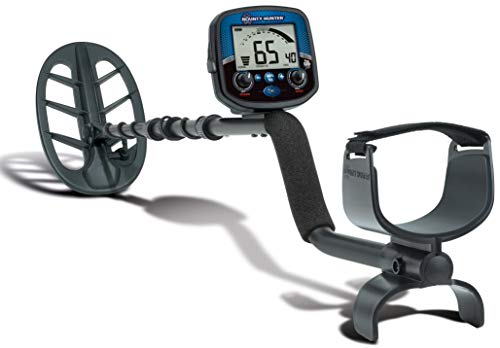
Bounty Hunter Time Ranger Pro
Bounty Hunter publishes V-Break tone discrimination, adjustable iron audio and an adjustable notch window on the Time Ranger Pro, which is the control set that lets you work iron-heavy ground without blocking half the scale.
Price was accurate when this page was compiled and changes often.
On this page
What scale does the Time Ranger Pro use?
A two-digit numeric target ID on a 99 step conductivity scale, as specified in the Time Ranger Pro manual, with iron at the bottom and good conductors at the top. It shares that scale with the Bounty Hunter Land Ranger Pro, so numbers transfer reasonably well between the two machines, though not exactly, because the filtering and the tone handling differ.
The backlit display matters more than it sounds. A target ID you cannot read at dusk is a target ID you do not have, and a great deal of productive detecting happens in the last hour of light. Bounty Hunter publishes the backlight specifically for dawn, dusk and shaded conditions, and it is one of the practical reasons to choose this machine over the cheaper one.
As always, the number is an estimate of conductivity rather than an identification. The machine is telling you what class of metal it thinks is down there, and it is guessing from a weak signal through several inches of dirt.
What does each target read?
Positions on the 99 step scale, expressed as bands. Treat the spread as real rather than as vagueness.
The Time Ranger Pro places iron at the bottom of its 99 step scale and silver at the top, with the tab and small gold overlap sitting squarely in the middle where no setting can separate them.
| Target | Position on the scale | With iron audio on | Notes |
|---|---|---|---|
| Nails and small iron | Bottom | Distinct low grunt | Audible iron is the point of this machine |
| Large corroded iron | Bottom, spikes upward | Grunt plus a high false | Hearing both is how you identify it |
| Steel bottle cap | Jumps across the middle | Mixed, unrepeatable | Cross-sweep and it falls apart |
| Foil, small | Low | Clean, short | Same band as the smallest gold |
| Small gold ring | Low to low middle | Clean, short | There is no gold-specific number |
| US nickel | Low middle | Clean | Your calibration target |
| Lead, brass buttons | Low to middle | Clean | Relic band. Keep it open on old sites |
| Pull tab | Middle | Clean | Overlaps mid-size gold |
| Screw cap | Upper middle | Clean | Close to zinc cents |
| Zinc cent | Upper middle | Clean | Corrodes badly and then reads low |
| Copper cent | Upper | Strong | Patina pulls it down |
| Clad dime | Upper | Strong | Fades earlier than a quarter |
| Silver dime | High | Strong | Deep silver reads in the copper band |
| Quarter and silver quarter | High | Strong and wide | Flat iron imitates this band |
| Half dollar and larger | Top | Very wide | Check the signal footprint first |
The 99 step two-digit target ID is specified in the Time Ranger Pro manual. Per-target positions are the consensus of owner reports rather than a published specification, and they move with depth, soil and corrosion.
Why is adjustable iron audio worth paying for?
Because rejecting iron and hearing iron are different strategies, and the second one finds more. When you discriminate iron out, the machine goes silent over it, which means you cannot tell the difference between clean ground and ground so full of nails that a good target is being masked. You walk over an iron-choked hot spot and hear nothing, and you conclude there is nothing there.
Adjustable iron audio lets you keep iron audible at a reduced volume. Bounty Hunter publishes this as a variable control rather than an on-off switch, so you can set it to a level where nails register as a quiet grunt underneath the good signals. On an old house site that changes how you work: the iron tells you where the structure was, and a clean high tone sitting inside a carpet of grunts is the signal worth kneeling for.
The cost is fatigue. An iron-heavy site with iron audio turned up is genuinely tiring to listen to for three hours, which is why the control is adjustable rather than fixed. Headphones help more than volume does, and a cheap wired set like the Garrett MS-2 Headphones is enough to hear the faint signals a speaker loses to wind.
How should you set V-Break and the notch window?
V-Break moves where the tone changes. The notch window removes a band entirely. Confusing the two is the most common setup mistake on this machine.
V-Break changes the pitch at a point you choose while leaving every target audible, whereas the notch window silences a band completely, which is why V-Break is the safer control to experiment with.
| Setting | Effect on what you hear | Use it when | Risk |
|---|---|---|---|
| V-Break just above iron | Iron low, everything else high | Relic sites and old ground | Very little. The usual default |
| V-Break above the foil band | Foil and small gold read low | Foil-strewn parks, coin hunting | You stop noticing small gold |
| V-Break high near the coin band | Only good conductors ring high | Dense trash, coins only | Most relics and all gold |
| Notch window on the tab band | Tabs go silent | Parks where tabs outnumber everything | Mid-size gold rings, completely |
| Notch window narrow | One small band removed | A specific repeated piece of junk | Anything sharing that band |
| Notch window wide | A large span removed | Rarely a good idea | A great deal, silently |
| Iron audio low | Nails audible but quiet | Iron-heavy sites, long sessions | None worth worrying about |
| Iron audio off | Silence over iron | Clean parks only | You cannot tell masked ground from empty ground |
Bounty Hunter publishes V-Break, adjustable iron audio and an adjustable notch window with customisable notch width for the Time Ranger Pro. The consequences follow directly from what each control does to the signal.
Is it worth the step up from the Land Ranger Pro?
If you hunt iron, yes, and the reason is adjustable iron audio rather than anything to do with depth. Both machines carry the same eleven inch waterproof DD searchcoil and the same Ground Grab balancing, so raw performance on clean ground is close. What you are buying is control over what you hear.
If you hunt mown parks in daylight and dig anything above the tab band, the Bounty Hunter Land Ranger Pro does that job and the extra money is better spent on a pinpointer. The Garrett Pro-Pointer AT is submersible to twenty feet with three sensitivity levels, and it will cut your recovery time more than any upgrade to the detector will.
Compare the two directly with the Land Ranger Pro chart, or see what you give up entirely on an analog machine in the Tracker IV settings chart. For the scale used by a comparable machine from another brand, the Quest Q40 chart is the closest match, and the budget ID comparison covers the whole class. Kit lists sit under intermediate setups.
Sources
- Bounty Hunter Time Ranger Pro owner’s manual, target ID, V-Break and iron audio sections
- Bounty Hunter Time Ranger Pro published specification, 11 inch waterproof DD searchcoil and backlit display
- Bounty Hunter published description of Ground Grab computerised ground balancing with manual override
Frequently asked questions
What target ID scale does the Time Ranger Pro use?
A two-digit numeric target ID on a 99 step conductivity scale, as documented in the Time Ranger Pro manual, shared in principle with the Land Ranger Pro. Iron occupies the bottom of the scale and good conductors such as copper and silver the top. Numbers transfer roughly between the two machines but not exactly, because the tone handling and filtering differ, so re-baseline if you move between them.
What is the difference between V-Break and the notch window?
V-Break moves the point at which the tone changes pitch, leaving every target audible. The notch window silences a band of the scale completely so you never hear those targets at all. V-Break is the safer control because a bad setting only sounds wrong, whereas a bad notch quietly deletes finds. Most people set V-Break just above the iron grunt and leave the notch alone.
Why would I want to hear iron rather than reject it?
Because silence over iron cannot be distinguished from silence over empty ground. On an old house site, dense iron both indicates where the structure stood and masks good targets sitting inside it. Keeping iron audible at low volume, which is what adjustable iron audio provides, tells you when you are standing on a hot spot worth working slowly rather than walking past it.
Does the backlit display actually matter?
More than most specification-sheet features. Bounty Hunter publishes the backlight for dawn, dusk and shaded conditions, and a large share of productive detecting happens in the last hour of daylight when a normal LCD becomes unreadable. If you regularly hunt after work, a display you can read without a torch is a genuine practical advantage rather than a convenience.
Can I use the Time Ranger Pro in shallow water?
The coil can. Bounty Hunter publishes the eleven inch DD searchcoil as waterproof and suitable for shallow water or damp environments, which covers wading at the water line and wet sand. The control box is not rated for submersion. On wet salt sand expect to lower sensitivity substantially, since salt raises the noise floor on any single-frequency machine regardless of brand.
Researched, not professional advice. This page is compiled from published specifications, manuals and owner-review consensus, not hands-on testing. Target ID numbers, depth figures and settings vary with soil chemistry, moisture, target size, depth, orientation and firmware version, so treat every figure here as a starting point and verify it against your own machine's manual and your own ground. As an Amazon Associate we earn from qualifying purchases.