Quest Q40
Quest Q40 Target ID Chart: Reading the Scale on a Light Machine
Quick answer
The Quest Q40 manual specifies a two-digit target ID on a 0 to 99 scale. Iron reads below roughly 20, foil and small gold 20 to 40, nickels near 30 to 40, pull tabs 40 to 55, and copper, clad and silver coins from about 60 to 95. Soil and depth move all of it.
Quest is a smaller brand than Fisher or Minelab, and the Quest Q40 reflects that in a useful way: it is built around weight, battery and convenience rather than around a feature list. Quest publishes a built-in rechargeable lithium battery, low latency wireless Lite headphones in the box, a water-resistant build, fast-release cam-lock three section rods and a light ergonomic body.
It also enjoys aftermarket coil support from CORS and NEL, which is unusual at this price and genuinely extends the machine's useful life. The target ID scale is conventional, so this page covers the bands and then spends its time on what is actually different about owning one.
Top pick
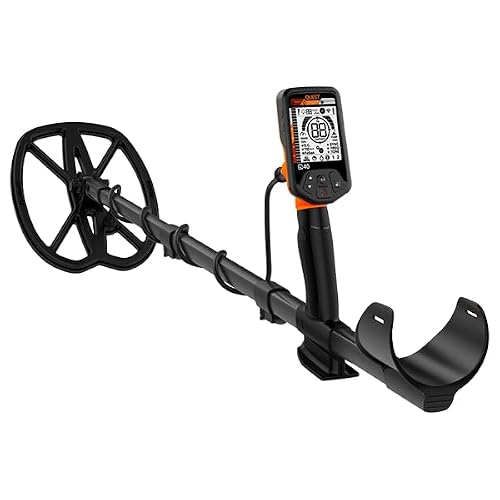
Quest Q40
Quest ships the Q40 with a built-in rechargeable lithium battery and low latency wireless headphones included, on a light body with cam-lock rods, which removes most of the usual first-year accessory spending.
Price was accurate when this page was compiled and changes often.
On this page
What scale does the Quest Q40 use?
A two-digit numeric target ID on a 0 to 99 conductivity scale, as specified in the Q40 manual. That is the same convention used by almost every modern machine with a screen, which means the ordering is familiar and notes from another 0 to 99 detector will broadly transfer.
Broadly, not exactly. Operating frequency, filtering and firmware all shift where a given target lands, so a quarter that reads 82 on a Fisher will not necessarily read 82 here. Treat carried-over notes as a rough map and rebuild them properly against your own machine in your own ground.
The definition worth keeping in mind is the same on every detector: the target ID is the machine's estimate of a target's electrical conductivity, expressed as a number. It is not an identification, and it is being estimated from a weak signal through several inches of dirt.
What does each target read on a Q40?
Bands rather than values, because a single number would misrepresent how any detector behaves in real soil.
On a Quest Q40 the coin bands sit where a 0 to 99 scale puts them, with clad and silver from roughly 68 to 95, and the 40 to 55 tab band overlapping mid-size gold as it does on every machine.
| Target | Typical Q40 ID | Stability | Notes |
|---|---|---|---|
| Nails and small iron | 1 to 15 | Erratic, broken | Low tone. Leave unless relic hunting |
| Large corroded iron | 1 to 20, spikes high | Falses from one angle | Cross-sweep before believing a high number |
| Steel bottle cap | 20 to 60 | Poor, jumps | Unrepeatability is the tell |
| Foil, small | 18 to 30 | Fair when shallow | Shares the band with the smallest gold |
| Small gold ring | 20 to 40 | Fair when shallow | No detector has a gold number |
| US nickel | 28 to 40 | Good when shallow | Carry one as a calibration target |
| Lead and small brass | 25 to 55 | Fair | Wide band. Relic and beach interest |
| Pull tab | 38 to 52 | Good | Overlaps mid-size gold rings |
| Screw cap | 50 to 65 | Good | Close to zinc cents |
| Zinc cent | 56 to 68 | Good, fades when deep | Corroded examples read lower |
| Copper cent | 66 to 78 | Good | Patina pulls the number down |
| Clad dime | 68 to 80 | Good | Thin, fades before a quarter does |
| Silver dime | 76 to 86 | Good | Deep silver drops into the copper band |
| Quarter and silver quarter | 80 to 90 | Strong | Large flat iron can imitate it |
| Half dollar and larger silver | 88 to 95 plus | Strong, wide | Check the footprint before digging |
The 0 to 99 two-digit target ID is specified in the Quest Q40 manual. Per-target bands are the consensus of owner reports rather than a Quest specification, and every one of them shifts with soil chemistry, moisture, depth, orientation and corrosion.
What does the sealed lithium battery change?
Quest publishes a built-in rechargeable lithium battery rather than AA cells, and that is a real trade rather than a straightforward upgrade. On the good side, you never buy batteries, the weight is lower, and voltage stays steady through the session instead of sagging. Sagging cells change how a detector behaves before they stop it working, which is a genuinely annoying failure mode that sealed lithium avoids.
On the other side, you cannot swap a flat battery in the field. When it is done, the day is done, and there is no equivalent of dropping in a fresh set of Rechargeable AA NiMH Batteries, 8 pack cells the way you would on an Fisher F22 or an Fisher F75. A USB power bank in the pouch is the standard workaround and worth carrying from the start.
Wireless audio draws from that same battery. Quest includes low latency wireless Lite headphones in the box, which is a meaningful saving given that ordinary Bluetooth headphones are unusable for detecting: normal Bluetooth delay makes pinpointing by ear impossible, which is why detector brands build their own low latency protocols. Running them costs runtime, and the battery runtime calculator will tell you roughly how many hunts a charge gives you.
Why does aftermarket coil support matter at this price?
Coil choice changes a machine more than most settings do, and on a smaller brand the availability of third-party coils is not guaranteed.
A smaller coil improves separation in trash and a larger one covers more ground per sweep, which is why third-party support from CORS and NEL genuinely extends what a Q40 can do.
| Coil choice | What improves | What gets worse | Right for |
|---|---|---|---|
| Smaller than stock | Separation in dense trash, pinpointing | Ground covered per hour, depth on large targets | Old house sites, trashy parks |
| Stock coil | Balanced compromise | Nothing in particular | General detecting, learning the machine |
| Larger than stock | Ground covered, depth on larger targets | Separation, weight, arm fatigue | Open fields, beaches, pasture |
| Elliptical rather than round | Working between obstacles and iron | Slightly less coverage per sweep | Iron-infested ground where you still want reach |
General coil behaviour, consistent across brands. Quest Q40 aftermarket coils are produced by CORS and NEL; confirm fitment for your specific machine revision before buying.
Who should buy a Q40 rather than a mainstream machine?
Someone who values weight and convenience over brand support. The Q40 is light, the rods release quickly for transport, the battery is sealed and rechargeable, and the headphones are already in the box. For a detectorist who wants to grab a machine and go without assembling a kit first, that adds up.
The argument against is service and community. Fisher, Garrett, Minelab and Nokta have far more owners, which means more forum knowledge, more second-hand coils and easier repairs. If you like solving problems by searching for someone who has had the same one, a mainstream machine is the safer purchase. The Fisher F22, the Nokta Simplex Ultra and the Minelab Vanquish 340 all compete at or near this money with much larger user bases.
For the closest comparable machines, see the Teknetics G2+ chart and the Time Ranger Pro chart. The budget detector ID comparison lays out what each brand actually publishes about its scale, which is the most honest way to compare them. Kit lists sit under intermediate setups.
Sources
- Quest Q40 owner’s manual, target ID and discrimination sections
- Quest published Q40 specification, rechargeable lithium battery and wireless headphones
- CORS and NEL published coil compatibility listings for Quest detectors
Frequently asked questions
What target ID range does the Quest Q40 use?
The Q40 manual specifies a two-digit numeric target ID on a 0 to 99 scale, the same convention used by most modern detectors with a screen. Iron reads at the bottom and good conductors like copper and silver at the top. Quest does not publish per-target values, because the number any given coin produces depends on depth, orientation, corrosion and soil chemistry.
Can I replace the Quest Q40 battery in the field?
No. Quest publishes a built-in rechargeable lithium battery rather than removable cells, so when it runs down the session ends. The upside is steady voltage through the hunt and no battery purchases, since sagging alkaline cells change how a detector behaves before they fail outright. Carry a USB power bank if you regularly hunt longer than a single charge comfortably covers.
Are the included wireless headphones actually usable?
Yes, because Quest includes low latency wireless Lite headphones designed for detecting rather than ordinary Bluetooth. That distinction matters: normal Bluetooth introduces enough audio delay to make pinpointing by ear impossible, which is why every detector brand that offers wireless builds its own low latency protocol. Getting a matched set in the box is a genuine saving at this price point.
Is the Quest Q40 waterproof?
Quest publishes it as water-resistant rather than submersible, which covers rain, damp grass and splashes rather than putting the control box under water. If you intend to wade regularly or hunt the surf line, a machine with a published submersion rating is the correct purchase. Treating a water-resistant machine as a waterproof one is an expensive way to learn the difference.
Why do my Q40 numbers differ from other detectors?
Because operating frequency, filtering and firmware all shift where a target lands on the scale, even when two machines share the same 0 to 99 convention. Add soil chemistry, moisture, depth, orientation and corrosion and the differences compound. Notes from another detector are a rough map at best. Bury known targets in your own soil, let it settle, and record what your own machine reports.
Researched, not professional advice. This page is compiled from published specifications, manuals and owner-review consensus, not hands-on testing. Target ID numbers, depth figures and settings vary with soil chemistry, moisture, target size, depth, orientation and firmware version, so treat every figure here as a starting point and verify it against your own machine's manual and your own ground. As an Amazon Associate we earn from qualifying purchases.