Bounty Hunter Land Ranger Pro
Bounty Hunter Land Ranger Pro Target ID Chart: 99 Points Explained
Quick answer
Bounty Hunter publishes 99 points of target ID resolution and a four-tone target ID for the Land Ranger Pro. Iron reads at the bottom of that scale, nickels near the low middle, pull tabs through the middle, and copper, clad and silver coins toward the top. Depth, soil and corrosion move every band.
The Bounty Hunter Land Ranger Pro is the machine where Bounty Hunter stops being a toy brand. It publishes 99 points of target ID resolution, four-tone target ID, seven modes of operation, programmable target discrimination, computerised Ground Grab balancing, and an eleven inch waterproof DD searchcoil, which is an unusual amount of coil for the price.
Bounty Hunter also states that it finds coin-sized targets on the surface and buried up to ten inches deep. That figure and the 99 point scale are the two published numbers worth building a chart around, so this page does exactly that and then explains why your own numbers will differ.
Top pick
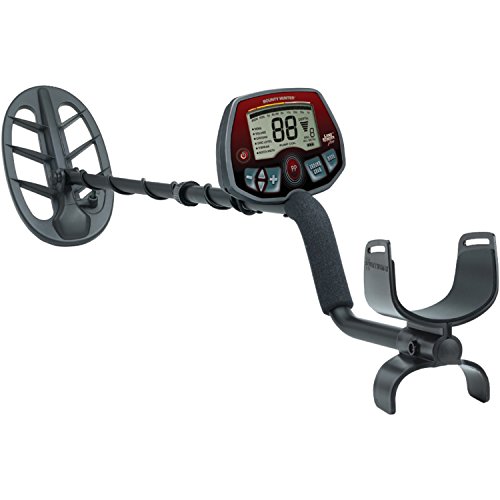
Bounty Hunter Land Ranger Pro
Bounty Hunter publishes 99 points of target ID resolution, four-tone target ID and an eleven inch waterproof DD searchcoil on the Land Ranger Pro, which is a great deal of coil and resolution for the money.
Price was accurate when this page was compiled and changes often.
On this page
What does 99 points of target ID resolution mean?
It means the machine sorts targets into 99 discrete steps along a conductivity scale rather than into a handful of broad categories. That is the definition, and it is the difference between a detector that tells you roughly what class of metal is down there and one that lets you distinguish a zinc cent from a copper cent before you dig.
Resolution is not accuracy. Ninety-nine steps only help if the underlying measurement is stable, and the measurement gets less stable as targets get deeper, as soil mineralisation rises, and as targets corrode. A machine can report a very precise number that is very wrong. What the resolution genuinely buys you is the ability to notice that a signal is repeating at the same point every sweep, which is the real tell for a good target.
Bounty Hunter pairs the scale with four-tone target ID, so each broad band also has its own pitch. In practice most people end up using the tones for fast decisions and the number for the marginal ones.
What does each target read on a Land Ranger Pro?
These are bands owners consistently report on the published 99 point scale. The width of each band is the honest part.
On a Land Ranger Pro the pull tab band in the low middle of the 99 point scale overlaps mid-size gold rings almost exactly, which is why beach and jewellery hunters dig tabs rather than notching them out.
| Target | Typical ID band | Tone | Notes |
|---|---|---|---|
| Small nails and iron | Bottom of the scale | Lowest | Grunts and breaks up. Leave unless relic hunting |
| Large corroded iron | Bottom, spikes upward | Lowest, erratic | Falses high from one angle. Always cross-sweep |
| Steel bottle cap | Jumps across the middle | Inconsistent | Instability is the tell rather than any single number |
| Foil, small | Low, above iron | Low | Shares this band with the smallest gold |
| Small gold ring | Low to low middle | Low to mid | No number on any machine means gold |
| US nickel | Low middle | Mid | The best calibration target to carry |
| Lead and small brass | Low to middle, wide | Mid | Relic band. Discrimination here is costly |
| Pull tab | Middle | Mid | Overlaps mid-size gold rings |
| Screw cap | Upper middle | Mid to high | Reads close to zinc cents |
| Zinc cent | Upper middle | High | Degrades quickly with depth and corrosion |
| Copper cent | Upper | High | Patina pulls the reading down |
| Clad dime | Upper | High | Thin target, fades before a quarter does |
| Silver dime | High | High | Deep silver drops into the copper band |
| Quarter | High | High | Large flat iron can imitate this |
| Half dollar and larger silver | Top of the scale | High | Wide signal. Check the footprint first |
Bounty Hunter publishes 99 points of target ID resolution and four-tone target ID for the Land Ranger Pro, and does not publish per-target values. The bands above describe relative positions on that scale from owner reports, which is why they are expressed as positions rather than as invented exact numbers.
How much depth should you actually expect?
Bounty Hunter states that the Land Ranger Pro finds coin-sized metal targets on the surface and buried up to ten inches deep, on the eleven inch DD waterproof searchcoil it ships with. Read that the way you would read a fuel economy figure: it describes favourable conditions with a favourable target, and it is a ceiling rather than an expectation.
Three things pull it down. Mineralised soil reduces both depth and ID stability, and does so sharply on red clay and iron-rich ground. Target size matters more than most people allow: a small gold earring is not a coin-sized target and will be found at a fraction of that depth. And target orientation costs you depth on anything sitting on edge.
The DD coil is genuinely helpful here. A DD winding produces a narrow blade-shaped detection field rather than the cone a concentric coil produces, which improves both ground coverage and target separation in trash. That is why an eleven inch DD at this price is worth remarking on, and the expected detection depth calculator will give you a realistic band for your own soil rather than the brochure figure.
What do the seven modes and the notch actually change?
Bounty Hunter publishes seven modes of operation plus programmable target discrimination. The modes are preset discrimination patterns rather than different technologies.
Every mode on the Land Ranger Pro other than all metal works by removing signals before you hear them, so each one trades finds for time in a way worth choosing deliberately.
| Mode or setting | What it does | Right for | What it removes |
|---|---|---|---|
| All metal | Responds to everything | Relic sites and unfamiliar ground | Nothing. You dig it all |
| Coin hunting preset | Rejects iron and low bands | Mown parks and lawns | Small gold and most relics |
| Jewellery preset | Keeps the low and middle bands open | Beaches and swimming areas | Little. You will dig tabs |
| Relic preset | Rejects only the iron band | Old house sites and fields | Iron, which is usually the point |
| Custom discrimination | You choose which bands are silent | Sites you know well | Exactly what you told it to |
| Ground Grab balancing | Tunes the machine to soil mineralisation | Any mineralised ground | Nothing. Use it on every site |
| Notch window | Silences one band while keeping those above it | Foil-heavy or tab-heavy parks | Whatever sits inside the notch |
Bounty Hunter publishes seven modes, programmable target discrimination and one-button Ground Grab computerised ground balancing for this machine. Mode names vary between manual revisions, so check yours.
Where does it sit against the rest of the range?
Below it, the Bounty Hunter Tracker IV is an analog machine with no screen and no numbers at all, which makes it a different proposition rather than a cheaper version of the same thing. The Bounty Hunter Junior is a children's machine with a target strength meter rather than a target ID.
Above it, the Bounty Hunter Time Ranger Pro runs the same eleven inch waterproof DD coil and adds V-Break tone discrimination, adjustable iron audio, a backlit display and an adjustable notch window with customisable width. If you hunt in low light or in heavy iron, those additions are the reason to pay the difference. Outside the brand, the Fisher F22 and the Teknetics Delta 4000 compete directly on price.
For a machine with none of this, read the Tracker IV settings chart, which explains what an analog detector gives you instead. The Time Ranger Pro chart covers the step up, the budget ID comparison puts the brands side by side, and the best lists cover buying decisions.
Sources
- Bounty Hunter Land Ranger Pro owner’s manual, target ID, modes and Ground Grab sections
- Bounty Hunter Land Ranger Pro published specification, 99 points of target ID resolution and 4-tone target ID
- Bounty Hunter published depth statement for the Land Ranger Pro, coin-sized targets to ten inches
Frequently asked questions
What is the target ID range on a Bounty Hunter Land Ranger Pro?
Bounty Hunter publishes 99 points of target ID resolution together with a four-tone target ID system, which makes it a 99 step conductivity scale with iron at the bottom and good conductors like silver at the top. What Bounty Hunter does not publish is a per-target lookup table, because the number any given coin produces depends on its depth, orientation, corrosion and the soil it is sitting in.
How deep will the Land Ranger Pro detect a coin?
Bounty Hunter states it finds coin-sized metal targets on the surface and buried up to ten inches deep with the stock eleven inch DD searchcoil. Treat that as a ceiling in favourable soil rather than an expectation. Mineralised ground, smaller targets and coins sitting on edge all reduce it considerably, and the target ID becomes unreliable well before the depth limit is reached.
Is the eleven inch DD coil too big for trashy parks?
Sometimes. A DD winding gives a narrow blade-shaped detection field that separates targets better than a concentric coil of the same size, so it copes with trash better than the diameter suggests. Even so, in genuinely dense trash a large coil sees several targets at once and blends them. Slowing your sweep helps most, and overlapping each pass by about half a coil width helps more.
Should I use the preset modes or custom discrimination?
Start with the presets while you learn the machine, then move to custom discrimination once you know your sites. Every mode other than all metal works by deleting signals before you ever hear them, so the risk is that you never learn what you rejected. A useful habit is to work a small area in all metal first, then switch, so you know what the mode is actually costing you.
Why do my numbers not match this chart?
Because the chart describes a different patch of dirt. Soil chemistry, moisture, depth, target orientation, corrosion and firmware revision all shift target IDs, and two identical coins in two fields will read differently. The fix is a test garden: bury known targets at marked depths in your own soil, let the ground settle for several weeks, then record what your own machine says at each depth.
Researched, not professional advice. This page is compiled from published specifications, manuals and owner-review consensus, not hands-on testing. Target ID numbers, depth figures and settings vary with soil chemistry, moisture, target size, depth, orientation and firmware version, so treat every figure here as a starting point and verify it against your own machine's manual and your own ground. As an Amazon Associate we earn from qualifying purchases.