Detecting gear
Wired vs Wireless Headphones for Metal Detecting: The Choice That Isn't Either/Or
Quick answer
Low-latency wireless, such as the Minelab ML 80, is the right choice for dry-land detecting because it removes a cable without the lag of ordinary Bluetooth. Wired headphones are not optional once you go underwater, because wireless signals do not transmit through water at all. Anyone who submerges a machine needs both, not one or the other.

Minelab Equinox Waterproof Headphones
$170.00A wired, waterproof set for the Equinox series. Our catalog's listing for this product does not carry a usable published specification, so treat this description as fitment and price only.
Best for: submerging an Equinox
Check price on Amazon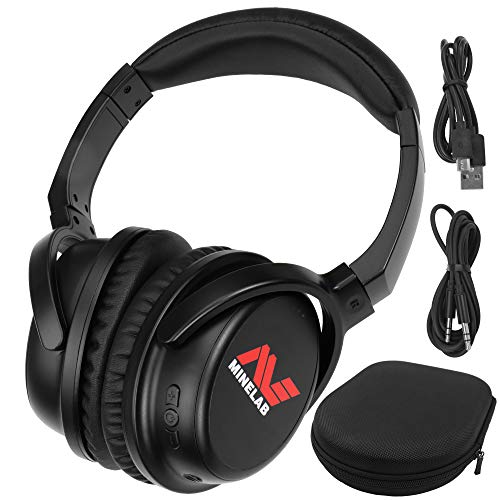
Minelab ML 80 Wireless Headphones
$150.00Low-latency Bluetooth wireless, compatible with the Minelab Equinox and Vanquish platforms, sold with a carrying case, aux cable and charging cable.
Best for: Equinox 600 and 800 owners
Check price on AmazonThis is not really a choice between two products, it is a choice about where you detect, because radio waves do not propagate through water the way they do through air. The Minelab ML 80 publishes low-latency Bluetooth built specifically for detectors, compatible with the Equinox and Vanquish platforms, for $150.00, and that low latency matters because ordinary consumer Bluetooth headphones introduce enough delay to make pinpointing by ear genuinely difficult. On dry land, a matched wireless set like this is the better everyday choice for most detectorists.
Underwater, none of that applies. Minelab's Equinox Waterproof Headphones, at $170.00, exist specifically because a submerged machine cannot reach a wireless receiver at all, wired or not, so a wired connection through a sealed cable is the only way audio reaches your ears once the coil and control box go under. The saltwater detecting guide covers the rest of what changes once you are actually in the water.
Top pick
Minelab ML 80 Wireless Headphones
Low-latency Bluetooth built specifically for detector audio, compatible with the Equinox and Vanquish platforms, without the delay of ordinary consumer Bluetooth.
Price was accurate when this page was compiled and changes often.
On this page
Why does wireless fail completely underwater, rather than just getting weaker?
Radio frequency signals, including Bluetooth and the low-latency wireless protocols detector makers use, are absorbed very quickly by water. This is basic physics rather than a manufacturer limitation: it is why submarines use extremely low frequencies and trailing wire antennas to communicate at all, and why no consumer wireless headphone protocol is built to punch through more than a few inches of water reliably. So the choice between wired and wireless is not a spectrum of convenience, it is a hard cutoff at the waterline.
That is exactly why Minelab Equinox Waterproof Headphones exists as a separate, wired product from Minelab ML 80 Wireless Headphones rather than Minelab simply making the ML 80 waterproof. A note on the catalog record here: our listing for the Equinox Waterproof Headphones does not carry a usable manufacturer specification, so this page describes it only by its name, its price and the machines it fits, and says plainly that we cannot cite feature detail for it beyond that.
What actually separates low-latency wireless from ordinary Bluetooth?
Delay. Ordinary consumer Bluetooth headphones are built for music and video, where a small delay between the source and your ears is imperceptible. Detecting audio needs to arrive close to instantly, because you are using the exact tone and its timing relative to coil position to judge a target's size and depth, especially while pinpointing. Nokta, Garrett and Minelab each publish their own low-latency wireless systems for this reason: Nokta's for The Legend, Garrett's Z-Lynk, and Minelab's ML-series for the Equinox, Manticore and X-Terra Pro platforms.
Garrett MS-3 Z-Lynk Wireless Headphones is Garrett's Z-Lynk set and also pairs with a Z-Lynk pinpointer, and Nokta Bluetooth Low Latency Headphones for The Legend is Nokta's matched low-latency set for The Legend. None of these are interchangeable with each other or with generic Bluetooth headphones, and buying an unmatched wireless pair is the most common way people end up frustrated with lag they assume is the detector's fault.
Wired and wireless options, side by side
The row for the Equinox Waterproof Headphones below is deliberately thin, because this page will not print a feature claim for it that our catalog cannot source.
Low-latency wireless sets from Minelab, Nokta and Garrett solve the on-land lag problem that ordinary Bluetooth has, and wired, waterproof sets are the only option once a machine goes fully underwater.
| Option | Type | Best for |
|---|---|---|
| Minelab ML 80 Wireless Headphones | Low-latency wireless | Dry-land Equinox and Vanquish detecting |
| Minelab ML105 Wireless Headphones | Low-latency wireless | Manticore, Equinox 700/900 and X-Terra PRO owners with more than one machine |
| Nokta Bluetooth Low Latency Headphones for The Legend | Low-latency wireless | The Legend, on land |
| Garrett MS-3 Z-Lynk Wireless Headphones | Low-latency wireless (Z-Lynk) | AT Max and any Z-Lynk-enabled Garrett |
| Minelab Equinox Waterproof Headphones | Wired, waterproof | Submerging an Equinox series machine |
| Thresher Submersible Headphones for Nokta | Wired, submersible to 100+ ft | Submerging a Simplex or Legend |
| Garrett Submersible Headphones | Wired, submersible | Submerging a Garrett AT series machine |
| Gray Ghost Amphibian Headphones for Minelab | Wired, waterproof to 200 ft | Aftermarket submersible option for Minelab owners |
Types and fitment are drawn from each product's own catalog listing. The Equinox Waterproof Headphones entry lists only what our catalog can source for that product; see the callout above for why.
Choose low-latency wireless if
You detect on dry land or shallow, non-submerged conditions and want to remove the cable between the detector and your ears without the lag that makes ordinary consumer Bluetooth unusable for pinpointing. Match the set to your platform: Minelab ML 80 Wireless Headphones or Minelab ML105 Wireless Headphones for current Minelab machines, Nokta Bluetooth Low Latency Headphones for The Legend for The Legend, and Garrett MS-3 Z-Lynk Wireless Headphones for any Z-Lynk-enabled Garrett. The best wireless headphones roundup covers more options across brands.
Choose it too if you already own more than one current Minelab detector, since Minelab ML105 Wireless Headphones publishes compatibility across the Manticore, Equinox 700, 900 and X-Terra Pro from a single pair.
Choose a wired, waterproof set if
Submerging the detector is part of your plan at all, whether that is wading, surf hunting or diving. Wireless is not an option once the coil and control box go under, full stop, so this is not a preference decision the way choosing between two wireless sets is. Thresher Submersible Headphones for Nokta covers Nokta owners submerging a Simplex or Legend, and Garrett Submersible Headphones covers the Garrett AT series.
Choose the specific set matched to your machine rather than assuming any wired headphone works, since the connector and impedance matching still matter even without wireless in the picture. The beach detecting guide covers the rest of what changes when water becomes part of the hunt.
What else changes once water is involved?
The pinpointer, for one. Garrett Pro-Pointer AT is submersible to 20 feet and Nokta PulseDive Pinpointer doubles as a small scuba unit, and neither depends on your headphone choice to function. CKG Titanium Sand Scoop or CKG 304 Stainless Sand Scoop become relevant the moment you are recovering targets from wet sand rather than turf, which is a separate gear decision covered on the titanium versus stainless scoop comparison.
Sources
- Minelab ML 80 Wireless Headphones product listing
- Minelab ML105 Wireless Headphones product listing
- Nokta and Garrett wireless headphone product listings
Frequently asked questions
Can I use any Bluetooth headphones with my detector?
Technically often yes, but ordinary consumer Bluetooth headphones introduce enough delay that pinpointing by ear becomes genuinely harder, since detecting relies on hearing a tone change at almost the exact instant the coil passes over a target. Manufacturer-matched low-latency sets, such as the ML 80 for Minelab or Z-Lynk headphones for Garrett, are built specifically to avoid that lag.
Why does wireless fail underwater instead of just working with more static?
Radio frequency signals, including the ones detector wireless systems and Bluetooth use, are absorbed very quickly by water rather than merely weakened, so there is no realistic power increase that restores a usable signal once a receiver is submerged. This is a physical limitation of radio in water, not something a specific product or brand has failed to engineer around.
Do I need different wired headphones for different brands?
Generally yes, because the connector, impedance and, for waterproof sets, the sealing design are built around a specific machine or platform. A set built for the Garrett AT series is not automatically the right choice for a Nokta Simplex, so match the wired set to your actual machine rather than assuming any 1/4 inch plug will perform the same underwater.
Is it worth buying both a wireless and a wired set?
If you ever submerge the machine, yes: the wireless set covers dry-land comfort and the wired set covers the one situation wireless cannot handle at all. If you never go past the waterline, a matched low-latency wireless set alone is enough, and the wired option is not something you need to buy speculatively.
Researched, not professional advice. This page is compiled from published specifications, manuals and owner-review consensus, not hands-on testing. Target ID numbers, depth figures and settings vary with soil chemistry, moisture, target size, depth, orientation and firmware version, so treat every figure here as a starting point and verify it against your own machine's manual and your own ground. As an Amazon Associate we earn from qualifying purchases.