Best detectors
Best Metal Detector Headphones: Low Latency, Wired and Submersible
Quick answer
Buy headphones made for detectors, not for music. Ordinary Bluetooth adds enough delay that the tone arrives after the coil has passed the target, so pinpointing by ear stops working. Minelab ML105 Wireless Headphones at $180.00 covers several current Minelabs. Wireless does not work under water, so a submerged machine needs a wired waterproof set.
Headphones are the one accessory that changes what you hear rather than what you carry, and detector audio is not music. The information you are listening for is a faint change in pitch and volume at the edge of the threshold, arriving at the exact moment the coil crosses the target. Two things destroy that: a speaker that flatters the midrange, and any delay at all between the coil and your ear.
That second point is the one worth reading twice. A pair of ordinary Bluetooth headphones, the kind that are excellent on an aeroplane, adds enough latency that the tone reaches you after the coil has already moved on. You can still hear that a target is there. You can no longer tell exactly where it is, which is the whole reason you are wearing them. Detector makers sell low latency sets for this reason, and every one of them advertises the latency figure rather than the frequency response. If you want to understand what the tones are telling you in the first place, the guide on reading a detector signal is the place to start, and the pinpointer roundup covers the tool that finishes the job in the hole.
Top pick

Minelab ML105 Wireless Headphones
Minelab publishes this set as working with the Manticore, Equinox 700 and 900 and X-Terra Pro from one pair, with low latency wireless and a detachable AUX cord that converts it to wired when the battery dies.
Price was accurate when this page was compiled and changes often.
On this page
- Why do ordinary Bluetooth headphones not work on a metal detector?
- How do the main sets compare on what the makers publish?
- What should a first pair of detector headphones cost?
- When is a low latency wireless set worth the money?
- What do you need if the machine actually goes under water?
- What if your hearing is not what it was?
Why do ordinary Bluetooth headphones not work on a metal detector?
Because of delay. Standard Bluetooth audio is buffered, and the buffer is there to stop music stuttering. For music a delay of a fraction of a second is invisible. For detecting it is fatal, because the useful part of a detector signal is its position in time: the tone has to rise and fall while the coil is over the target, so that your ears and your arm agree about where the target is. Move the tone even slightly later and every target appears to be somewhere it is not, and you start cutting holes in the wrong place.
This is why the makers sell their own sets and why the word they print is latency. Minelab describes the ML105 as using enhanced low-latency technology for minimal time delay and a faster detection response. Garrett sells Z-Lynk and describes it in the ACE Apex listing as six times faster than Bluetooth. Nokta sells a Bluetooth low latency set specifically for The Legend. Those are three different radio systems and they are not interchangeable, so match the set to the machine before you match it to the price.
The second hard limit is water. Radio does not travel through water in any useful way, so no wireless set works submerged, whatever its own water rating says. A machine rated to 16 feet, which covers most of the fully waterproof models in the waterproof roundup, is only as useful under water as the wired waterproof headphones plugged into it. That is not a preference, it is physics, and it is the single most common expensive mistake in this category.
How do the main sets compare on what the makers publish?
Only figures each manufacturer prints appear below. Several listings say nothing about a water rating, and those cells say so. A gap is more useful than an invented number.
Published prices run from $33.99 for a plain wired Garrett pair to $180.00 for the low latency Minelab set, and only the wired submersible sets carry a published depth rating at all.
| Set | Price | Connection | Water rating published | Machines the maker names |
|---|---|---|---|---|
| Minelab ML105 | $180.00 | Low latency wireless, converts to wired with the supplied AUX cord | None published | Manticore, Equinox 700 and 900, X-Terra Pro |
| Minelab ML 80 | $150.00 | Low latency Bluetooth, AUX cable supplied | None published | Equinox 600 and 800 |
| Minelab ML85 | $125.00 | Low latency wireless | None published | Manticore |
| Nokta low latency Bluetooth | $110.99 | Bluetooth low latency | None published | Nokta The Legend |
| Nokta 2.4 GHz Green Edition | $118.99 | 2.4 GHz with a supplied transmitter | None published | Machines with no wireless of their own, and the PulseDive |
| Garrett MS-3 | $107.99 | Z-Lynk receiver built in, 30 to 18,000 Hz | None published | Garrett Z-Lynk machines and transmitters |
| Garrett MS-2 | $33.99 | Wired, quarter inch right angle plug, 10 ft coiled cable | None published | Any machine with a quarter inch socket |
| Gray Ghost Original | $109.95 | Wired | None published | Single-output machines |
| Gray Ghost Platinum | $129.95 | Wired, quarter inch right angle, selector switch | None published | All single-output machines without adapters |
| Minelab Equinox waterproof | $170.00 | Wired waterproof | Not stated in this listing | Minelab Equinox series |
| Garrett submersible | $149.99 | Wired submersible | Not stated in this listing | Garrett AT series |
| Gray Ghost Amphibian | $169.95 | Wired submersible | Waterproof to 200 feet | Minelab Manticore and Equinox |
| Thresher submersible | $157.99 | Wired submersible | 100 feet plus | Nokta Simplex and Legend |
Prices come from the catalog and move. Compatibility and depth figures are quoted from the maker listing named in the sources. No set on this page has been listened to by us, and nothing here is a measured latency comparison.
What should a first pair of detector headphones cost?
Under fifty dollars, and there is no shame in it. Your first machine probably has a speaker, and the speaker is fine in a quiet field. Headphones earn their money in wind, near traffic, and on a beach where surf noise sits on top of exactly the faint signals you are straining for. A plain wired pair solves that for the price of a tank of fuel, cannot run out of battery, and has zero latency by construction because there is no radio in the path at all.

Garrett MS-2 Headphones
$33.99Garrett publishes a quarter inch right angle stereo plug, a reinforced 10 ft coiled cable, volume control to lift weak signals and 8 ohm speakers. At $33.99 this is the pair that lives in the bag permanently as the spare, and plenty of people never replace it.
Best for: a first pair, and the permanent backup in the bag
Check price on Amazon
Gray Ghost Original Headphones
$109.95DetectorPro has built Gray Ghost sets around detector audio rather than music for a long time, and the Original is the cheapest way into that family. Wired, so nothing to charge and nothing to pair, which also means it works on a machine that has no wireless of its own.
Best for: an older machine with no wireless and a budget under a hundred dollars
Check price on Amazon
Nokta 2.4 GHz Wireless Headphones, Green Edition
$118.99A 2.4 GHz set supplied with its own transmitter, so it makes a machine wireless that was never built for it. Nokta also lists it as compatible with the Nokta PulseDive Pinpointer pinpointer, which means one set can serve the detector and the pinpointer on the same hunt.
Best for: making a cabled machine wireless without replacing the machine
Check price on AmazonWhen is a low latency wireless set worth the money?
When the cable has started to annoy you, which usually happens in the second season. A headphone cable snags on brush, drags across the control box, and is the reason a surprising number of people detect with the headphones half off. The fix is a wireless set built on the detector maker own radio protocol, not a general purpose Bluetooth pair. Budget between $107.99 and $180.00 and buy the one that matches your machine, because the protocols do not cross over.
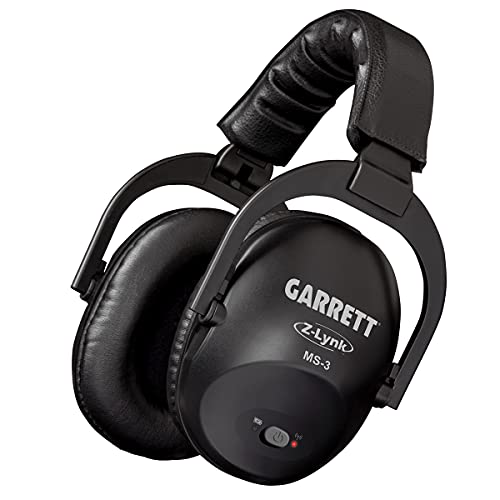
Garrett MS-3 Z-Lynk Wireless Headphones
$107.99Garrett publishes a built-in Z-Lynk receiver, volume control to raise weak signals, a foldable design and a 30 to 18,000 Hz response. It also pairs with the Garrett Pro-Pointer AT Z-Lynk, so the pinpointer audio arrives in the same cups as the detector audio and you stop pulling the headphones off to dig.
Best for: AT Max, Apex and Vortex owners already inside Z-Lynk
Check price on Amazon
Nokta Bluetooth Low Latency Headphones for The Legend
$110.99Nokta lists this set as Bluetooth low latency and specifically compatible with The Legend. Worth knowing before you budget: the Nokta Simplex Ultra listing states plainly that Bluetooth headphones are not included in the package, so on that machine this is a line item rather than an upgrade.
Best for: Nokta owners who want the matched set rather than a guess
Check price on Amazon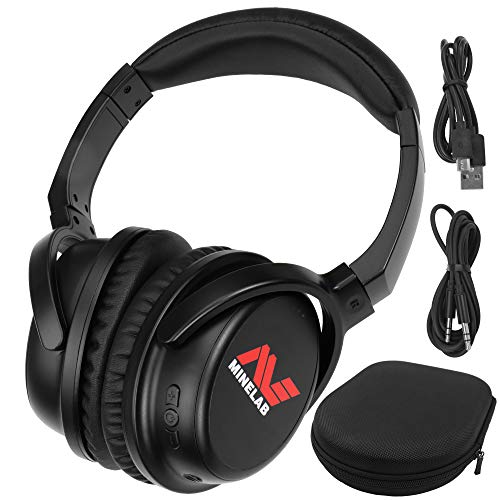
Minelab ML 80 Wireless Headphones
$150.00Minelab lists the ML 80 as compatible with the Equinox 600 and 800, and supplies a carrying case, an eighth inch AUX cable and a charging cable. If you are running the previous generation Equinox rather than a 700 or 900, this is the set the maker points you at.
Best for: Equinox 600 and 800 owners
Check price on Amazon Minelab ML105 Wireless Headphones
$180.00Minelab publishes compatibility with the Manticore, Equinox 700 and 900 and X-Terra Pro from one pair, enhanced low latency for minimal time delay, and a detachable 3.5 mm AUX cord plus USB-C charging. One pair covering several machines is what makes it the sensible buy if you own more than one current Minelab.
Best for: anyone running a current Minelab, or more than one of them
Check price on Amazon
Gray Ghost Original Platinum Headphones
$129.95DetectorPro publishes Platinum speakers made in the USA, a muff design that blocks ambient noise up to 24 decibels, and a selector switch that makes them work with all single-output machines without adapters. Noise blocking is the point: on a windy beach it is worth more than any tone setting.
Best for: chasing faint deep signals in wind and surf noise
Check price on AmazonWhat do you need if the machine actually goes under water?
A wired waterproof set, and there is no alternative. Wireless does not work submerged, so the moment the control box goes below the surface the only audio path left is a cable. This is the tier where people either spend correctly or waste the price of a coil, because a Minelab Equinox 900 rated to 16 feet with a wireless set on your head is a machine you cannot hear the instant it matters. Check the rating on your own machine in the Minelab depth ratings or the Nokta ratings before you buy anything here.

Gray Ghost Amphibian Headphones for Minelab
$169.95DetectorPro publishes a 200 foot waterproof rating, solid-state speakers built for wet or dry use, ambient noise blocking up to 24 decibels and a muff-to-muff cable with no screws and no wire frame to rust. Built for the Manticore and Equinox, which are the machines most likely to be taken under.
Best for: Minelab owners who genuinely submerge the machine
Check price on Amazon
Thresher Submersible Headphones for Nokta
$157.99Detecting Adventure publishes a 100 foot plus depth rating with oversized speaker elements and cords made in the USA. It exists because the Simplex and Legend both go under water while the wireless sets they ship with do not, which is exactly the gap that catches people out.
Best for: Simplex and Legend owners who wade, snorkel or dive
Check price on Amazon
Minelab Equinox Waterproof Headphones
$170.00Minelab sells this as the wired waterproof option for the Equinox series. If you want the set the manufacturer specifies for its own machine, with no adapter and no question about the connector, this is it, and the wired connection means it works the moment the coil goes under.
Best for: Equinox owners who want the factory answer
Check price on Amazon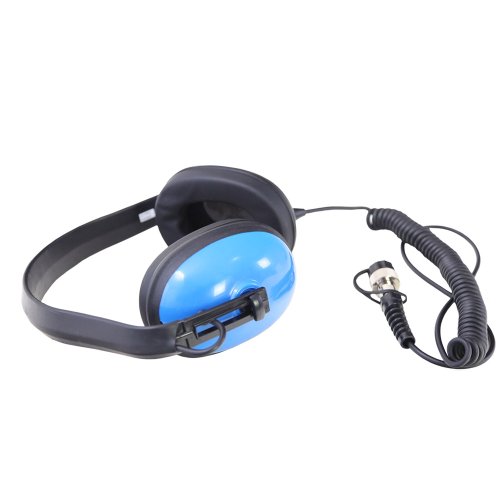
Garrett Submersible Headphones
$149.99The wired submersible set Garrett sells for putting an AT series machine under water. The Garrett AT Pro is published as submersible to 10 feet, and that rating is only usable if the audio can follow the machine down, which the wireless Garrett MS-3 Z-Lynk Wireless Headphones cannot do.
Best for: AT Pro, AT Max and AT Gold owners going below the surface
Check price on AmazonWho should not buy this tier: Do not buy a submersible set if you do not actually submerge the machine. They are wired, the cable is one more thing to snag on brush, and on dry land they do nothing a Gray Ghost Original Platinum Headphones at $129.95 does not do better for less. Wading a shoreline with the control box in the air is not submerging. Do not buy a wireless set on price alone either: a Z-Lynk pair will not talk to a Nokta machine and a Minelab pair will not talk to a Garrett, so a cheap set for the wrong protocol is money gone. And if your hearing has started to go, no headphone fixes that; look instead at the vibration feature discussed below, or at the machines on the seniors roundup.
What if your hearing is not what it was?
Then stop buying audio and start buying vibration, which is a genuine feature on several current machines rather than a gimmick. Nokta publishes vibration alerts on the Nokta Simplex Lite, and Minelab publishes handgrip vibration on the Minelab X-Terra Pro, the Minelab X-Terra Elite, the Minelab Equinox 700 and the Minelab Equinox 900. The handle buzzes when the machine sounds off, so the signal reaches you through your palm rather than your ears. Owners with hearing loss consistently report that this is the feature that keeps them in the hobby.
The other honest answer is volume control on the headphone itself rather than on the machine. Both the Garrett MS-2 Headphones and the Garrett MS-3 Z-Lynk Wireless Headphones publish a volume control intended to lift weak signals, which lets you run the detector at a sensible level and do the lifting at your ear. That is a better arrangement than winding the machine volume up, because a machine at maximum volume flattens the difference between a faint deep signal and a loud shallow one, and that difference is most of what you were listening for.
How we chose
We have not held any of this gear and we will not pretend otherwise. There is no in-person listening test behind this page. Every claim about latency, depth rating and machine compatibility is quoted from the maker listing or manual named in the sources at the foot of the page, and where a maker publishes no figure the table says so instead of carrying a guess. The ordering is built from what each set is documented to do, what it costs, and which machine it is actually specified to work with, because a wireless set paired to the wrong protocol is an expensive pair of ordinary headphones.
Sources
- Minelab ML105, ML85 and ML 80 product listings and specifications
- Minelab Equinox waterproof headphone product listing
- Garrett MS-2 and MS-3 Z-Lynk product specifications
- Nokta wireless headphone product listings for The Legend and the Green Edition set
- DetectorPro Gray Ghost Original, Platinum and Amphibian specifications
- Detecting Adventure Thresher submersible headphone specifications
Frequently asked questions
Can I use normal Bluetooth headphones with a metal detector?
You can pair them on machines that use standard Bluetooth, and you will regret it. Ordinary Bluetooth buffers audio, and that delay means the tone reaches your ears after the coil has passed the target, so pinpointing by ear stops working. Detector makers sell low latency sets precisely because of this. Minelab advertises minimal time delay on the Minelab ML105 Wireless Headphones rather than advertising sound quality, which tells you what matters.
Do wireless headphones work under water?
No. Radio does not travel usefully through water, so no wireless set works once the machine is submerged, whatever water rating the headphones themselves carry. A machine rated to 16 feet needs a wired waterproof set such as the Minelab Equinox Waterproof Headphones or the Gray Ghost Amphibian Headphones for Minelab to be usable below the surface. Wading with the control box in the air is different and wireless is fine for that.
Are expensive detector headphones actually better?
They are better at the specific job, which is not the same as sounding better. What you pay for is ambient noise blocking, speakers tuned to the faint end of the range, and a connector that survives being dragged through wet grass. DetectorPro publishes 24 decibels of ambient noise reduction on the Gray Ghost sets. On a windy beach that is worth more than any tone adjustment on the machine.
Will Garrett Z-Lynk headphones work with a Minelab detector?
Not directly. Z-Lynk is Garrett own wireless protocol, Minelab uses its own low latency system and Nokta uses another again, so a set bought for one brand will not pair with another. The one way round it is a transmitter: the Nokta 2.4 GHz Wireless Headphones, Green Edition ships with its own 2.4 GHz transmitter, which plugs into a machine that has no wireless of its own.
Do I need headphones at all if my detector has a speaker?
Not at first. A speaker is adequate in still air on quiet ground, and plenty of people hunt that way for a season. Headphones start to matter in wind, near roads and on a beach, where surf noise sits directly on top of the faint deep signals you are listening for. They also stop your machine annoying everybody else in a public park, which is worth something on its own.
Researched, not professional advice. This page is compiled from published specifications, manuals and owner-review consensus, not hands-on testing. Target ID numbers, depth figures and settings vary with soil chemistry, moisture, target size, depth, orientation and firmware version, so treat every figure here as a starting point and verify it against your own machine's manual and your own ground. As an Amazon Associate we earn from qualifying purchases.