Garrett gold machines
Garrett Goldmaster 24k Settings Chart: Why 48 kHz Finds Small Gold
Quick answer
Garrett specifies the Goldmaster 24k at 48 kHz, a single high operating frequency. That is roughly five times the frequency of a general coin machine, and it is the reason the 24k responds to small gold that a coin detector passes over in silence, at the cost of more ground noise and less depth on large silver.
Almost everything about the Goldmaster 24k follows from one published specification: Garrett runs it at 48 kHz. A general-purpose coin machine operates far lower, and the difference is not a refinement, it is a different job. At 48 kHz the machine responds to sub-gram gold that a coin detector cannot usefully see, and in exchange it sees mineralised ground, hot rocks and iron far more vividly than a coin machine ever will.
This page is about what that means in the field: what to set, what to expect, and what the machine is genuinely bad at. If you are weighing it against a general machine, read it alongside the Apex frequency chart, which tops out at 20 kHz.
Top pick
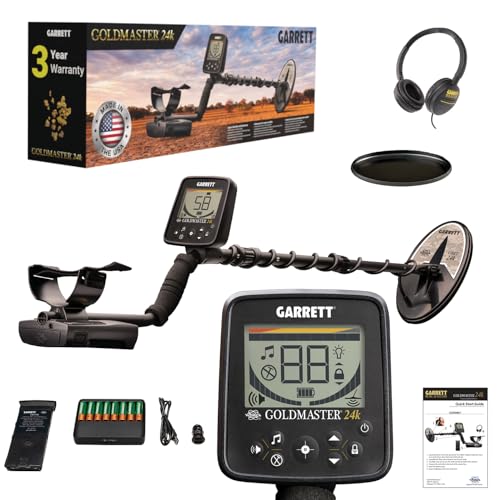
Garrett Goldmaster 24k
Garrett specifies 48 kHz, which is where very small gold gives a usable signal and where a coin machine gives none.
Price was accurate when this page was compiled and changes often.
On this page
Why does 48 kHz matter so much for small gold?
A buried object signals back because the detector's changing field drives eddy currents in it. How strong those currents are depends on the target's size, its shape, its conductivity and the rate at which the field changes. A small, thin, relatively poorly conductive object such as a sub-gram gold nugget supports very little current at low frequency, so a coin machine hears nothing. Raise the frequency and the field changes far faster, the induced current rises, and the nugget becomes audible.
That is the whole argument for a high-frequency prospecting machine and it is why the specification is worth more attention than any feature list. Garrett's own AT Gold is published at 18 kHz, which Garrett describes as enhanced detection for small gold nuggets, jewellery, coins and relics. The Goldmaster 24k at 48 kHz is aimed considerably further down the size scale than that.
How does 48 kHz compare with the rest of the field?
Every figure below comes from the manufacturer's own published specification for that machine.
Garrett publishes 48 kHz for the Goldmaster 24k against 18 kHz for its own AT Gold and a 20 kHz maximum on the ACE Apex, which is the gap that decides whether sub-gram gold is audible at all.
| Machine | Published frequency | Built for | Weak at |
|---|---|---|---|
| Garrett Goldmaster 24k | 48 kHz single high frequency | Fine gold in known goldfields | Deep large silver, and quiet running in bad ground |
| Fisher Gold Bug 2 | 71 kHz | The smallest gold, where almost nothing else responds | Everything that is not small gold |
| Minelab Gold Monster 1000 | 45 kHz | Small gold with fully automatic setup | Manual control for those who want it |
| Garrett AT Gold | 18 kHz | Small gold and mineralised relic ground | The very smallest gold |
| Garrett ACE Apex | Up to 20 kHz, plus multi | General detecting with a gold-capable top end | Prospecting for natural gold |
| Garrett ACE 400 | Single frequency, given in the spec sheet | Coins, jewellery and relics | Natural gold of any size |
Frequencies are as published by each manufacturer. A higher frequency improves response to small low-conductive targets and worsens both ground noise and depth on large high conductors. No frequency figure predicts performance on its own, because coil size, ground balance quality and soil mineralisation all matter as much.
What does a 48 kHz machine demand from the operator?
Discipline about ground balance, above all. At 48 kHz the soil itself is a loud target in mineralised country, and a machine that is not balanced to the ground is useless rather than merely degraded. Rebalance whenever the ground changes character, which in a goldfield can be every few dozen paces.
Second, sweep speed. Small targets give short signals, and a fast sweep passes over them before the machine has resolved anything. Slow to a pace that feels absurd and then slow down again. Third, hot rocks: high-frequency machines respond strongly to mineralised stones, and learning the sound of your local hot rock is a real part of the job.
What settings should you start from?
These are starting points on a machine whose correct settings are more site-dependent than any coin detector's.
In heavily mineralised goldfield ground, sensitivity on a 48 kHz machine is usually set well below maximum, because the soil response rather than the electronics is the limiting factor.
| Ground | Sensitivity | Ground balance | Sweep | Expect |
|---|---|---|---|---|
| Mild soil, low mineralisation | High | Balance once, check hourly | Slow | The machine at its best |
| Heavily mineralised goldfield | Well below maximum | Rebalance constantly | Very slow, coil on the ground | Noise, and small signals inside it |
| Hot rock country | Moderate | Rebalance at every ground change | Slow, and lift-test suspect signals | Many false signals from stones |
| Old tailings and worked ground | Moderate | Frequent | Very slow, tight grid | Iron rubbish alongside missed gold |
| Wet creek gravels | Moderate to high | Frequent | Slow | Better conditions than dry dust |
| Salt-affected ground | Low | Frequent, and expect difficulty | Short sweeps | A high-frequency machine struggling |
Starting points only. The Goldmaster 24k owner's manual is the authority on the controls your machine carries and what each does. In prospecting ground the correct sensitivity is almost always lower than new owners expect, because the soil response rather than the electronics sets the ceiling.
What is a 48 kHz machine genuinely bad at?
Coins. A high-frequency machine gives up depth on large, high conductive targets, and its target identification in the coin range is less useful than a purpose-built coin machine's. It is also noisier and more demanding in ordinary park soil, where a lower frequency would run quietly. Nobody should buy a Goldmaster 24k as a general detector, and anybody selling it that way is not doing you a service.
The honest recommendation is that this is a second machine, or a first machine only if you live near goldfields and prospecting is the point. For general use, the Apex or the Vortex VX9 is the better buy, and the nugget value tool will tell you how much gold you would need to find for the specialist machine to pay for itself.
What goes with a prospecting machine?
Prospecting kit differs from coin-hunting kit mainly in how much of it has to survive heat, dust and long walks.
Garrett Goldmaster 24k
$679.99Garrett specifies 48 kHz, which is where very small gold gives a usable signal, at $679.99.
Best for: fine gold in known goldfields
Check price on Amazon
Garrett AT Gold
$640.99Published at 18 kHz with a ground balance window for varying soil, and submersible to ten feet, so it also works as a relic machine.
Best for: mineralised relic ground and larger gold
Check price on Amazon
Garrett Pro-Pointer AT
$109.99Three sensitivity levels and a fast retune that tunes out mineralised ground, which is exactly the ground you will be in.
Best for: recovering small targets in hot soil
Check price on AmazonHow we chose
We did not test these machines in person and we publish no find claims. Picks are researched from manufacturer specifications and owner manuals, published listing features, waterproof ratings and warranty terms, and the recurring themes in verified owner reviews. We favour the established detector brands because coils, shafts and control boxes have to stay available years after a model is discontinued, and we place every pick in the tier where its price and capability honestly belong.
Sources
- Garrett Goldmaster 24k owner's manual and published specification, for the 48 kHz operating frequency
- Garrett AT Gold published listing, for the 18 kHz operating frequency and ground balance window
- Minelab Gold Monster 1000 published listing, for the 45 kHz VLF specification
- Fisher Gold Bug 2 published listing, for the 71 kHz operating frequency
Frequently asked questions
What frequency does the Garrett Goldmaster 24k run at?
Garrett specifies 48 kHz, a single high operating frequency. That is the defining specification of the machine and the reason it responds to small gold that lower-frequency detectors pass over. It is also why it is noisier in mineralised ground and shallower on large silver coins than a general-purpose machine would be in the same soil.
Will a Goldmaster 24k work as a coin detector?
Poorly, relative to a machine built for it. High frequency costs depth on large high-conductive targets such as silver and copper coins, and the target identification in that range is less informative than on a coin machine. It will certainly detect coins. It is simply the wrong tool, and a general machine will out-find it on a park every time.
Is 48 kHz better than 45 or 71 kHz for gold?
Better is the wrong frame. Minelab publishes 45 kHz for the Gold Monster 1000 and Fisher publishes 71 kHz for the Gold Bug 2, and each sits at a different point on the same trade: higher frequency finds smaller gold and suffers more from mineralisation. Coil size, ground balance quality and operator patience matter at least as much as the headline number.
Why does my high-frequency machine scream in goldfield soil?
Because at 48 kHz the mineralised ground itself is a strong target. The cure is ground balance rather than sensitivity: rebalance whenever the soil changes character, which in prospecting country can be every few dozen paces. Only after the machine is balanced should you set sensitivity, and in bad ground it will end up well below maximum.
Do I need a permit to prospect with a metal detector?
In many jurisdictions, yes, and the rules for prospecting are stricter than for general detecting. Mineral rights are often separate from surface rights, active claims are private property, and public land frequently requires a permit or licence. Check the rules for the specific parcel before you go, and get written permission from the landowner or claim holder.
Researched, not professional advice. This page is compiled from published specifications, manuals and owner-review consensus, not hands-on testing. Target ID numbers, depth figures and settings vary with soil chemistry, moisture, target size, depth, orientation and firmware version, so treat every figure here as a starting point and verify it against your own machine's manual and your own ground. As an Amazon Associate we earn from qualifying purchases.