Minelab water machines
Minelab Excalibur II Settings And Depth: An Analog Machine With No Target ID Numbers
Quick answer
The Excalibur II is an analog BBS machine with no numeric target ID, so you identify targets by tone rather than by a number. Minelab publishes a 1.5 to 25.5 kHz broad band spectrum design and a NiMH pack giving up to 12 hours. Depth depends on the target, the ground and the salt.
Anybody arriving at the Minelab Excalibur II 1000 from a modern screen machine needs to reset their expectations in one specific way: there is no target ID number, and there is no screen to put one on. This is an analog detector. You listen, you judge, and you dig. That sounds like a step backwards until you have used one in surf, where a machine that just keeps working in salt is worth more than a display you cannot read anyway.
So this page is written around tone and depth rather than numbers, because inventing ID figures for a machine that does not produce them would be dishonest. What Minelab does publish is the BBS multiple frequency design spanning 1.5 kHz to 25.5 kHz, a receive coil design that amplifies weak target signals inside the coil to lift faint deep responses, a high visibility body and skid plate, and a rechargeable NiMH pack rated for up to 12 hours of operation.
Top pick
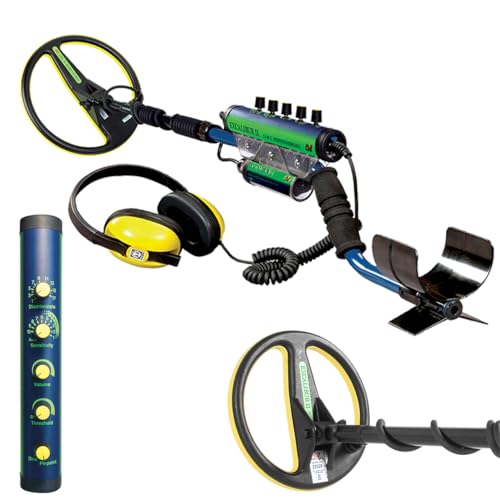
Minelab Excalibur II 1000
A broad band spectrum machine built for salt water and depth, and still the reference point for serious water hunting.
Price was accurate when this page was compiled and changes often.
On this page
Why does an analog machine still sell?
Because salt water is brutally unforgiving and the Excalibur II is built for exactly it. Minelab publishes a BBS multiple frequency design spanning 1.5 kHz to 25.5 kHz, which is what lets it handle conductive salt where single frequency machines struggle. The body is built to be submerged and dived rather than merely splashed, and the high visibility bodywork exists because dropped equipment on a sea bed is otherwise gone.
The absence of a screen is also the absence of a failure point and of something you cannot read through churned surf anyway. Water hunters tend to work by ear regardless, because visibility is often poor and because the machine is frequently below them rather than in front of them. What you give up is the ability to judge a marginal target without digging it, which in sand is less costly than it is on a lawn.
How do you identify targets without a number?
Tone carries the conductivity ordering. The ordering is the same as on every other machine, but you hear it instead of reading it.
The Excalibur II has no numeric target ID, so conductivity ordering arrives as tone: low conductors such as iron, foil and small thin gold produce lower responses, and high conductors such as silver and large coins produce higher, cleaner ones.
| Target class | Typical audio behaviour | What it usually is on a beach |
|---|---|---|
| Ferrous iron | Low, broken, unstable between passes | Nails, hooks, wire, fishing weights with iron in them |
| Foil and thin gold | Low but repeatable from several directions | Wrappers, occasionally a fine chain |
| Small gold rings and nickels | Low to mid, consistent | The target most water hunters are actually chasing |
| Pull tabs and aluminium | Mid, consistent | The main junk class above the tide line |
| Modern clad coins | Mid to high, clean | Dropped change, most common in swimming areas |
| Silver coins and large rings | High, clean, broad | The good day |
| Large flat iron and lids | High but inconsistent between directions | The classic false positive everywhere |
This is tone ordering rather than published figures, because Minelab publishes no numeric target ID for this machine. There is no ID number to quote and any page that gives you one for an Excalibur II has invented it.
What do the controls actually do?
The control set is short and analog: output level, a threshold you set by ear, a discrimination adjustment and a switch between discriminating operation and a non motion all metal style pinpoint function. Set threshold to a faint continuous hum rather than silence, because a threshold you can just hear is what lets you notice the small break that a deep target produces. Silence hides exactly the signals you bought this machine for.
Use discrimination sparingly. In salt water, rejecting too much costs you gold, because gold rings sit in the same conductive region as aluminium and the machine cannot separate them any better than a digital one can. Most experienced water hunters run relatively open and dig more, on the grounds that sand recovery is quick and the trash tells you where things accumulate. Check the exact control layout for your unit in the manual, because side mount and stock configurations differ.
What governs depth in salt water?
No manufacturer publishes a depth figure, and in salt water the variables are even larger than inland.
In salt water, target size and salinity dominate achievable depth, and sand movement matters more than either because a storm can put targets within reach or bury them a foot deeper overnight.
| Variable | Effect | What you can do |
|---|---|---|
| Target size | Large. A heavy ring or large coin is detectable far deeper than a thin chain | Know which target class you are hunting |
| Salinity and wet sand | Large. Conductive salt loads the machine and costs depth | A broad band spectrum machine exists precisely for this |
| Sand depth over the target | Decisive. Beaches gain and lose feet of sand seasonally | Hunt after storms and scouring tides where it is safe |
| Target orientation | Large. A ring on edge presents far less than one lying flat | Cross every doubtful signal from a second direction |
| Coil contact | Moderate. Water resistance tempts a high sweep | Keep the coil down, accept a slower sweep in surf |
| Black sand and mineral streaks | Moderate. Heavy mineral concentrations cost depth | Slow down, expect noise, work the edges |
No depth figure is published for this machine by Minelab, and no honest one can be given without naming the target, the sand condition and the salinity. Bury known targets at marked depths where you legally can, and find out what your own setup reaches.
Water hunting kit that actually matters
Audio and recovery, in that order. Wireless is not an option once you are under.

Gray Ghost Amphibian Headphones for Minelab
$169.95Wired and rated to 200 feet per the listing, with sound blocking muffs, which is what surf noise demands.
Best for: anyone hunting past their waist
Check price on Amazon
Minelab PRO-FIND 35
$99.00Waterproof to 10 feet per Minelab with ferrous tone ID, which saves a lot of sand sifting.
Best for: wet sand and shallow water recovery
Check price on Amazon Minelab Excalibur II 1000
$1,699.00Minelab publishes a BBS design spanning 1.5 to 25.5 kHz and a NiMH pack rated for up to 12 hours, built around salt water rather than adapted to it.
Best for: diving and surf hunting in salt water
Check price on AmazonHow we chose
We did not test these machines in person and we publish no find claims. Picks are researched from manufacturer specifications and owner manuals, published listing features, waterproof ratings and warranty terms, and the recurring themes in verified owner reviews. We favour the established detector brands because coils, shafts and control boxes have to stay available years after a model is discontinued, and we place every pick in the tier where its price and capability honestly belong.
Sources
- Minelab Excalibur II instruction manual, controls and operation chapters
- Minelab Excalibur II published product specification sheet
- Manufacturer listing specifications for the Excalibur II 1000, PRO-FIND 35 and Gray Ghost Amphibian
Frequently asked questions
Does the Excalibur II have a target ID number?
No. It is an analog machine with no numeric target identification and no screen to display one. You judge targets by tone and by how consistent a signal is from several directions. Any chart offering Excalibur II target ID numbers is fabricated, because the machine does not produce them. What it does produce is a stable audio response in salt water.
How long does the battery last?
Minelab publishes a rechargeable NiMH pack giving operation up to 12 hours. As with any published runtime, that figure assumes moderate use and a healthy pack, and a NiMH pack loses capacity as it ages. Measure your own runtime across three sessions, plan around the point where the tone changes rather than the point where it stops, and replace the pack when the figure drifts.
Is it better than a modern multi frequency machine on a beach?
It depends on how wet you get. For diving and deep surf work, its build and its broad band spectrum design remain the reason many water hunters still choose it. For a beach hunter who mostly works dry and wet sand and occasionally wades, a modern machine with a screen, lower weight and a target ID is easier to live with and more versatile inland.
How deep can I take it?
Minelab publishes a diving rating for the Excalibur II far beyond its land machines, and the figure quoted in its published material is 200 feet. Check the specification that came with your unit before diving it, inspect the seals, and treat any machine that has been dropped or knocked as suspect until you have checked it in shallow water.
Should I run discrimination in salt water?
Keep it light. Gold rings occupy the same conductive region as aluminium, so heavy discrimination costs you the target you went for. Most experienced water hunters run relatively open and dig more, because recovery in sand is quick and because the junk pattern on a beach tells you where heavier items are collecting. Reject iron, not the whole low conductive range.
Researched, not professional advice. This page is compiled from published specifications, manuals and owner-review consensus, not hands-on testing. Target ID numbers, depth figures and settings vary with soil chemistry, moisture, target size, depth, orientation and firmware version, so treat every figure here as a starting point and verify it against your own machine's manual and your own ground. As an Amazon Associate we earn from qualifying purchases.