Gifts by who they are
Metal Detecting Gifts for Kids: Why the Cheapest Detector Is the Unkind Choice
Quick answer
A slightly better machine is the kinder purchase. Toy detectors publish depth claims of roughly 4 to 5 inches, which finds bottle caps rather than treasure. For a child over about eight, Garrett ACE 200 at $149.99 is a real detector with a 0 to 99 target ID.
There is a hard fact under this category and it is worth stating before any recommendation. The very cheap detectors marketed as children's toys are limited machines, and the limitation that matters is depth. National Geographic publishes a 4 inch detection depth for its starter kit, and Bounty Hunter publishes 5 inches on coins for the Junior. In an ordinary lawn or park, almost everything findable at that depth is recent loose change, ring pulls and bottle caps.
Children are not put off by a detector being simple. They are put off by finding nothing. A machine with a real coil and a real target ID number finds an old coin in the first month rather than a handful of caps, and that first old coin is what turns an afternoon into a hobby. It also survives being handed down to a sibling. That is the entire argument of this page, and it is the same conclusion our roundup of children's machines reaches from the specifications.
Top pick

Garrett ACE 200
Garrett publishes a 0 to 99 digital target ID, a 6.5 by 9 inch waterproof PROformance searchcoil, a weight under 3 lb, an adjustable stem and a 3-year warranty, which makes it a real detector that keeps finding things as the child improves.
Price was accurate when this page was compiled and changes often.
On this page
Why do cheap toy detectors frustrate children?
Depth, and nothing else. A detector that reaches 4 inches will find things dropped in the last few years, because that is roughly how deep recent losses sit. Older coins have had decades to work their way down, and they are usually below that line. So the child sweeps for an hour, digs six signals, and comes back with a bottle cap, a ring pull and a nail. That is a fair description of what a 4 inch machine can reach, and it is not a criticism of any particular product: it is what very small coils and simple electronics do.
Weight is the second constraint, working in the opposite direction. National Geographic publishes 1.2 pounds for its starter kit, which is why a five year old can hold it up for an afternoon. Garrett publishes under 3 pounds for the Garrett ACE 200, which suits most children of eight or nine with the stem adjusted down. An adult flagship at 2.8 pounds sounds comparable and is not, because length and balance both work against a short arm. The gift decision is really a trade between those two numbers, and the right answer moves with the child's age.
What should you buy for a younger child?
Something light, cheap and forgiving, bought with clear eyes about what it will find. These are honest products at honest prices and both are genuinely designed for small users, but both are shallow, so pair them with somewhere interesting to search rather than expecting the machine to do the work.

National Geographic Starter Metal Detector Kit
$49.99National Geographic publishes 1.2 pounds, a 7.4 inch dual coil waterproof to 4 inches, LED and audio alerts, an adjustable arm and comfort grip, plus a heavy-duty trowel and a full-colour learning guide, at $49.99. The published detection depth is 4 inches, so expect recent drops.
Best for: children of about five to nine, and holidays at the beach
Check price on Amazon
Bounty Hunter Junior
$49.00Bounty Hunter designs it for ages 6 and up with an adjustable length, a built-in speaker and a target strength meter whose volume rises as the child closes in, plus a discrimination control to ignore nails. Published at 5 inches on coins and up to 3 feet on larger objects, at $49.00.
Best for: a first detector for a child of roughly six to nine
Check price on Amazon
Minelab GO-FIND 44
$218.99Minelab publishes a 10 inch 7.8 kHz waterproof coil, two camouflage skins and a carry bag, on a body that folds down small and weighs very little, at $218.99. The 10 inch coil is a real coil rather than a toy one, which is what lifts it above price-equivalent starter kits.
Best for: family trips, and smaller users who need something light
Check price on AmazonWhat is the kinder purchase for a child who is genuinely interested?
A real entry-level detector, and this is the recommendation the page exists to make. The difference is not marketing. It is a bigger coil, better electronics and a number on a screen that turns every signal into a small prediction the child gets to check by digging, which is the mechanic that makes the hobby stick.
Garrett ACE 200
$149.99Garrett publishes a 0 to 99 digital target ID with sharp audio, a 6.5 by 9 inch waterproof PROformance concentric searchcoil, an adjustable stem, a weight under 3 lb and a 3-year warranty, made in the USA, at $149.99. Garrett notes the coil is waterproof but the control box is not.
Best for: a child of about eight and up who has asked more than once
Check price on Amazon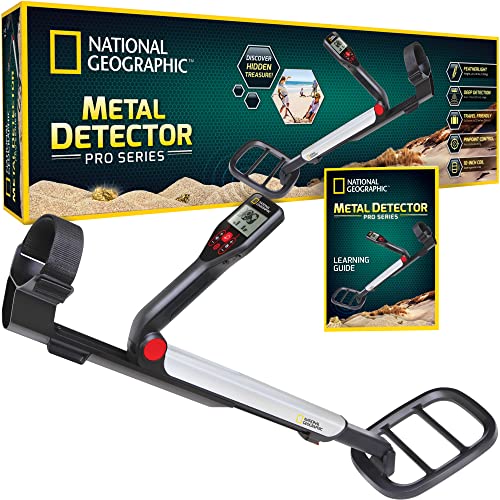
National Geographic PRO Series Metal Detector and Pinpointer Set
$159.95Bundles a detector with a pinpointer, which is the accessory that most shortens the learning curve for a child who lacks the patience to widen a hole. National Geographic publishes a 10 inch waterproof coil, an LCD display, 4 sensitivity levels, 3 detection modes and a claim of up to 12 inches, at $159.95.
Best for: an older child, or one kit shared between parent and child
Check price on Amazon
Bounty Hunter Tracker IV
$120.76An analog two-knob machine with no screen and nothing to configure, which is the point. Bounty Hunter publishes 2.6 lb, an 8 inch waterproof coil, three search modes, up to 25 hours of runtime, and a digger and carry pouch included, at $120.76.
Best for: a child who would be overwhelmed by a menu
Check price on AmazonWhich detector suits which age?
Depth claims are quoted exactly as each maker publishes them. Age bands are our judgement from published weight and control complexity, except where a manufacturer states an age itself.
Published depth claims for children’s machines run from 4 inches on the National Geographic starter kit to 5 inches on coins for the Bounty Hunter Junior, which is precisely why a real entry-level machine finds noticeably more.
| Machine | Price | Published weight or coil | Published depth claim | Realistic age |
|---|---|---|---|---|
| Bounty Hunter Junior | $49.00 | Adjustable, stated for ages 6 and up | Coins to 5 in, larger objects to 3 ft | About 6 to 9 |
| National Geographic Starter Kit | $49.99 | 1.2 lb, 7.4 in dual coil waterproof to 4 in | Objects up to 4 in | About 5 to 9, lightest here |
| Bounty Hunter Tracker IV | $120.76 | 2.6 lb, 8 in waterproof coil, no screen | Not published as a depth figure | About 8 and up |
| Garrett ACE 200 | $149.99 | Under 3 lb, 6.5 by 9 in waterproof coil | Not published as a depth figure | About 8 and up |
| National Geographic PRO Series | $159.95 | 10 in waterproof coil, collapsible | As deep as 12 in | About 9 and up |
| Minelab GO-FIND 44 | $218.99 | 10 in 7.8 kHz waterproof coil, folds for travel | Not published in this listing | About 8 and up |
| Garrett ACE 300 | $269.99 | 0 to 99 target ID with iron resolution | Not published as a depth figure | A committed child of about 11 up |
Depth claims are quoted verbatim from maker listings and are made on each maker’s own terms, not measured by us. Age bands are our judgement from published weight and control complexity. No machine here has been used by us.
What accessories actually keep a child interested?
The ones that deal with what happens after the signal. A child who finds a coin and cannot read the date loses interest quickly, so the Illuminated 30x and 60x Jewellers Loupe at $8.99 does more for enthusiasm than most equipment: it is illuminated, folds into a pocket, and turns a green disc into a dated object. The Cardboard Coin Flips, 300 in 6 sizes at $9.50 gives the finds somewhere to live, which makes a collection out of a jar, and the Digital Pocket Scale, 200 g by 0.01 g at $11.99 lets them weigh things, which children enjoy far more than adults expect.
For digging, the Root Slayer Heavy Duty Garden Trowel at $21.45 is stiff enough to be useful and has a serrated V tip, without being the genuinely sharp blade that a dedicated detecting digger carries. Keep the sharp Lesche-style tools for adults. A Mini Waterproof First Aid Kit at $9.99 belongs in the bag whoever is digging, because broken glass is common in old ground. And if the family is near water, the ASR Outdoor Gold Pan Beginners Kit, 5 piece at $16.95 is a good companion gift, since panning gives a child something to do on the days the detecting is slow. Most of these are small enough for a stocking, and the stocking filler list has more of them, while the beginner gift page covers the same ground for an adult starting out. Whatever they find, the habit of filling a hole properly is the one worth teaching on the first afternoon.
How we chose
No child of ours has used any of this and we are not going to invent a story about one. Depth claims, weights, coil sizes and age guidance are quoted from each manufacturer's own published listing, and where a maker states an age range we have used it rather than inventing one. Where no figure is published we say so. The ranking weights published depth capability and weight, because those two decide whether a child finds anything and whether they can hold the machine up.
Sources
- Garrett ACE 200 product listing
- Bounty Hunter Junior product listing
- National Geographic Starter Kit and PRO Series product listings
- Minelab GO-FIND 44 product listing
- Bounty Hunter Tracker IV product listing
Frequently asked questions
What age can a child start metal detecting?
Around five or six with a light machine and an adult doing the digging. Bounty Hunter states ages 6 and up for the Bounty Hunter Junior, and National Geographic publishes 1.2 pounds for its starter kit, which is the weight that makes it possible for a small child. From about eight, a real entry-level detector such as the Garrett ACE 200 becomes the better choice.
Are cheap metal detectors for kids any good?
They work, but they are shallow, and that is what disappoints children. The published depth claims are 4 inches for the National Geographic starter kit and 5 inches on coins for the Bounty Hunter Junior. At that depth most finds are recent loose change and bottle caps rather than anything old, which is why a slightly better machine is usually the kinder purchase.
Should I buy a child a real detector instead of a toy one?
If they are over about eight and have asked more than once, yes. The Garrett ACE 200 at $149.99 gives a 0 to 99 target ID, a 6.5 by 9 inch waterproof coil and a 3-year warranty, all for roughly three times a toy price. It finds older coins, it survives a second child, and the target ID number makes every dig a small experiment.
Is a pinpointer worth buying for a child?
Very much so, because children have the least patience for widening a hole to find something the machine has already located. The National Geographic PRO Series Metal Detector and Pinpointer Set bundles a pinpointer with the detector, which is the simplest way to cover it. Otherwise any standalone pinpointer works alongside any detector, so it is a safe gift.
What should a child not be given?
A genuinely sharp digging tool, and any expectation of treasure. Detecting diggers carry knife edges and serrated blades designed to cut root mat, so an adult should handle those. A stiff garden trowel such as the Root Slayer Heavy Duty Garden Trowel is the safer gift, and gloves matter because what comes out of old ground is often glass and rusted tin.
Researched, not professional advice. This page is compiled from published specifications, manuals and owner-review consensus, not hands-on testing. Target ID numbers, depth figures and settings vary with soil chemistry, moisture, target size, depth, orientation and firmware version, so treat every figure here as a starting point and verify it against your own machine's manual and your own ground. As an Amazon Associate we earn from qualifying purchases.