Gold machines
Fisher Gold Bug Pro vs Garrett AT Gold: Nearly the Same Frequency
Quick answer
Buy the Gold Bug Pro at $339.00 unless you need to get wet. Fisher publishes 19 kHz and Garrett publishes 18 kHz for the AT Gold at $640.99, so they sit in the same sensitivity class. The extra money buys submersion to 10 feet.
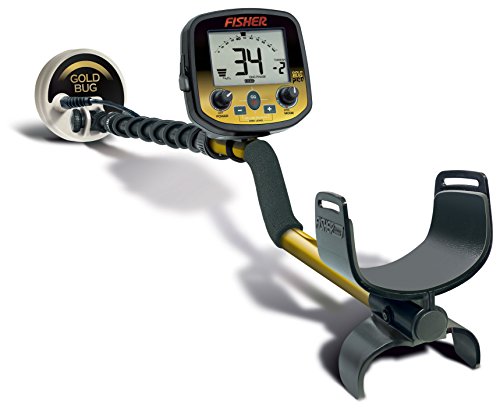
Fisher Gold Bug Pro
$339.0019 kHz, computerised ground grab with a live mineralisation readout, V-Break variable breakpoint tones, independent threshold and gain, 2.5 pounds.
Best for: small gold and mineralised relic ground on a lower budget
Check price on Amazon
Garrett AT Gold
$640.9918 kHz, fully submersible to 10 feet, true all metal mode, iron audio, manual and automatic ground balance with a ground balance window, made in the USA.
Best for: small gold and heavily mineralised ground
Check price on AmazonThese two sit in the same sensitivity class and the price difference buys waterproofing rather than gold performance. Fisher publishes a 19 kHz operating frequency for Fisher Gold Bug Pro and Garrett publishes 18 kHz for Garrett AT Gold. One kilohertz apart is not a performance difference, it is a rounding difference, and any page that builds a winner out of it is inventing one.
What genuinely separates them is the body and the controls. Garrett publishes full submersion to 10 feet for the AT Gold, along with a true all metal mode, iron audio and a ground balance window for handling variable soil. Fisher publishes for the Gold Bug Pro real-time computerised ground grab with a continuous ground condition and mineralisation readout, V-Break variable breakpoint tone discrimination, independent threshold and gain control, and a 2.5 pound weight. Those are two different philosophies at very different prices, and the frequency chart confirms both sit in the same band.
Top pick
Fisher Gold Bug Pro
19 kHz with real-time ground grab, a live mineralisation readout, V-Break tone discrimination and independent threshold and gain, at half the money.
Price was accurate when this page was compiled and changes often.
On this page
Are these actually gold machines or relic machines?
Both, and that is the most useful thing to understand before spending. At 18 and 19 kHz they sit above general coin machines and well below dedicated nugget detectors such as the 45 and 48 kHz machines. That middle band is genuinely good at two jobs: small gold that a coin machine misses, and relic hunting in mineralised soil where a low-frequency machine becomes unstable.
What they are not is specialist nugget hunters. If you are working known goldfields for the smallest gold, a higher-frequency machine will out-sensitise both of these, and the Gold Monster against the Goldmaster 24k covers that end. If you are hunting old homesteads and battle-adjacent farm fields in red mineralised dirt, these two are exactly right, which is why so many relic hunters own one. The relic roundup makes the same point.
How do the published specifications compare?
Two makers with similar disclosure habits here, which makes this a cleaner comparison than most gold pairings.
Both machines publish an operating frequency within one kilohertz of each other, and Garrett adds submersion to 10 feet and USA manufacture for roughly double the price.
| Model | Price | Made in |
|---|---|---|
| Fisher Gold Bug Pro | $339.00 | - |
| Garrett AT Gold | $640.99 | USA |
Figures are taken from each manufacturer's own published listing and specification sheet. A dash means the maker does not publish that figure for that model, not that the feature is absent.
What does the extra money buy?
Nine rows. One of them is submersion, and that is the row people are really paying for.
Fisher publishes 19 kHz with a live mineralisation readout and independent threshold and gain, and Garrett publishes 18 kHz with submersion to 10 feet and iron audio for roughly double the price.
| Specification | Fisher Gold Bug Pro | Garrett AT Gold |
|---|---|---|
| Price | $339.00 | $640.99 |
| Operating frequency | 19 kHz | 18 kHz |
| Water rating | Not published in this listing | Fully submersible to 10 ft |
| Ground balance | Computerised ground grab, real time | Manual and automatic, with ground balance window |
| Mineralisation readout | Continuous ground condition and mineralisation display | Not published in this listing |
| Tone control | V-Break variable breakpoint tone discrimination | Iron audio |
| All metal mode | Not published as a named mode | True all metal mode |
| Threshold and gain | Independent control of both | Not published in this listing |
| Weight | 2.5 lb | Not published in this listing |
| Made in | Not published in this listing | USA |
From the Fisher and Garrett listings. Rows marked not published are gaps in the listing rather than confirmed absences, and both machines have owner manuals that carry more detail.
Choose the Fisher Gold Bug Pro if
You hunt dry ground and want the most capability per pound spent. The live mineralisation readout is the underrated feature here: it tells you how hard your soil is working against you, which is information that changes how you set the machine and where you spend your afternoon. Very few detectors at any price show you that continuously.
Choose it too if you like to adjust. Independent threshold and gain control is the combination experienced prospectors ask for, because threshold sets what you hear at the edge of detection and gain sets how hard the machine drives, and being able to move them separately is how you work a noisy patch. At 2.5 pounds it is also light. The Gold Bug Pro settings chart is the operating reference.
Choose the Garrett AT Gold if
You work creeks, wet washes or shorelines. Submersion to 10 feet is the one thing the Gold Bug Pro does not publish, and in gold country a great deal of productive ground is in and around water. If you are dropping a coil into a creek bed regularly, that rating alone settles the argument and the price difference is justified.
Choose it too if you want one machine that also handles relics well in iron. Iron audio and a true all metal mode make the AT Gold a capable old-site detector, and the AT platform has coils behind it, including Garrett 5 by 8 DD PROformance Coil for tight ground and Mars Sniper 10 by 6 DD Coil as an aftermarket option. The AT Gold settings by site type page and its target ID chart cover the machine in use.
What does mineralised ground actually do to both?
It shortens depth and it adds noise. Iron mineralisation in soil returns its own signal, and the machine has to subtract that before it can hear a target, which costs sensitivity. This is why ground balancing exists, why both machines publish a ground balancing system, and why published depth figures from any maker mean very little in red dirt.
The practical consequence is that depth on either machine is a range tied to target size, coil and soil rather than a number. The expected detection depth calculator takes mineralisation as an input for exactly that reason, and how to ground balance is the skill that recovers most of what mineralisation takes. Neither machine does that thinking for you the way an automatic prospecting detector would.
Sources
- Fisher Gold Bug Pro product listing and specifications
- Fisher Gold Bug Pro owner manual
- Garrett AT Gold product listing and specifications
- Garrett AT Gold owner manual
Frequently asked questions
Is the AT Gold twice as good as the Gold Bug Pro?
No. They publish operating frequencies one kilohertz apart, which puts them in the same sensitivity class. The extra money buys full submersion to 10 feet, iron audio, a true all metal mode and USA manufacture. If you never detect in water, the honest conclusion is that the Gold Bug Pro gives you most of the capability for around half the price.
Can either of these be used for coin hunting?
Yes, better than a dedicated nugget machine would be. At 18 and 19 kHz they are higher than typical coin detectors, which makes them slightly noisier on mineralised ground and a little less confident on large silver, but both publish discrimination and tone control. Many relic hunters use exactly these machines on old sites for that reason.
Is the Gold Bug Pro waterproof?
The Fisher listing in our catalog does not publish a waterproof or submersion rating for the Gold Bug Pro, so treat the control box as needing to stay dry and check the current manual before taking it near water. Garrett publishes 10 feet for the AT Gold, which is the clearest single difference between the two machines.
Which is better in heavily mineralised red dirt?
Both are built for it, which is the point of this frequency band. The Gold Bug Pro publishes a continuous mineralisation readout that tells you how bad the ground is, and the AT Gold publishes a ground balance window that lets you accept a range of ground conditions. Those are different tools for the same problem, and neither maker publishes comparative figures.
Researched, not professional advice. This page is compiled from published specifications, manuals and owner-review consensus, not hands-on testing. Target ID numbers, depth figures and settings vary with soil chemistry, moisture, target size, depth, orientation and firmware version, so treat every figure here as a starting point and verify it against your own machine's manual and your own ground. As an Amazon Associate we earn from qualifying purchases.