Best by where you hunt
Best Metal Detectors for the Beach: What Actually Works on Wet Salt Sand
Quick answer
Wet salt sand is the hardest ground a detector faces, and simultaneous multi-frequency exists to solve it. Under $400 the Minelab X-Terra Elite carries Multi-IQ on a fully waterproof body. Above it the Minelab Equinox 700 and Minelab Equinox 900 are the standard answer, and both are submersible to 16 feet.
A beach is three different sites stacked next to each other. Dry sand above the high-tide line is barely mineralised and almost anything will run in it. The wet sand below that line is a sheet of salt water held in suspension, and it is the single most demanding ground most detectorists will ever swing over. The surf is worse again, and it moves.
Buy for the wet sand. That is where the rings are, because that is where cold hands shrink and wet fingers slip, and it is the zone a cheap machine cannot work. The rest of this page is organised by budget, but the dividing line that actually matters is whether the machine runs simultaneous multi-frequency. If you plan to go in past your knees, read the underwater machines page as well, because the headphone question changes completely once the control box goes under.
Top pick
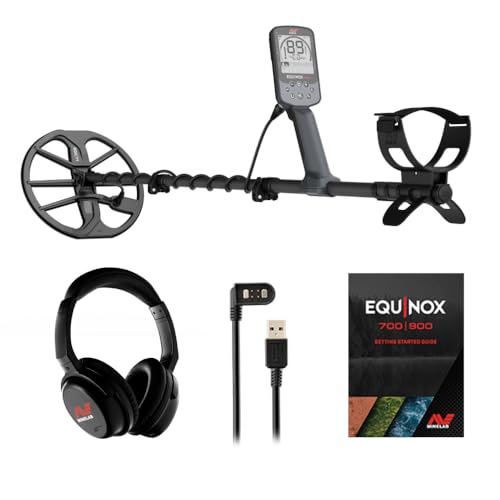
Minelab Equinox 900
Multi-IQ simultaneous multi-frequency, a dedicated Beach mode, both the 11 inch and 6 inch coils in the box, and 16 feet of published waterproofing at 2.8 lb.
Price was accurate when this page was compiled and changes often.
On this page
- Why does a cheap detector go mad on wet salt sand?
- Beginner: the cheapest kit that will not fight you in the wet
- Intermediate: the setup most serious beach hunters actually run
- Expert: depth in wet sand, and the specialists
- How do the beach machines compare on paper?
- Which scoop do you need, and why are they so expensive?
- Where on a beach are the targets, and how do you cover it?
Why does a cheap detector go mad on wet salt sand?
Salt water conducts. Wet sand is therefore a broad, shallow, conductive sheet, and a single-frequency VLF detector has no reliable way to tell that sheet apart from a large flat target lying just under the surface. So it chatters, it falses, and it loses depth in exactly the strip where the jewellery is. That is not a defect in any particular machine. It is what the technology does when you ask it to work in salt.
Simultaneous multi-frequency exists to solve that one problem. Minelab describes Multi-IQ on the Minelab Equinox 900 as running five frequencies at once, and both the 900 and the Minelab Equinox 700 carry a dedicated Beach mode on top of it. The Minelab X-Terra Elite puts the same Multi-IQ engine on the cheaper fully waterproof X-Terra body, which is why it is the value entry here. Garrett takes a different route: the ACE Apex lists a Multi-Salt setting alongside its single frequencies, and Garrett Vortex VX9 lists Multi-Salt as well.
None of this makes a machine magic. It makes it stable, and stability is what lets you run enough sensitivity to hear a thin gold band at depth. If you want the physics behind why frequency choice moves low-conductor targets at all, the frequency chart covers it, and the depth chart sets out what depth figures mean and do not mean.
Beginner: the cheapest kit that will not fight you in the wet
The temptation at this level is to buy the cheapest waterproof machine and sort the salt out later. It does not work that way, so the money goes on multi-frequency first and on everything else second. The Nokta Simplex Ultra deserves a mention here at $299.00: it is fully waterproof to 16 feet on a carbon fibre shaft that retracts to 25 inches, and it is a genuinely good wading and fresh-water machine. But Nokta sells it on waterproofing and build rather than on simultaneous multi-frequency, so for wet salt specifically the Multi-IQ machines are the safer buy.
The scoop is not optional. Recovering a target in wet sand by hand is how people spend twenty minutes on a bottle cap, and a cheap plastic one will not survive a season.

Minelab X-Terra Elite
$387.09Minelab puts Multi-IQ simultaneous multi-frequency on the fully waterproof X-Terra body, with two Beach search modes and 30 discrimination segments, at $387.09. That is the cheapest honest answer to wet salt sand in this catalog.
Best for: a first beach machine you will not outgrow in a season
Check price on Amazon
CKG 304 Stainless Sand Scoop
$89.99The same CKG design as the flagship scoops in 304 stainless at $89.99, which is roughly half what the titanium costs. Stainless will not rust out on you the way a mild steel scoop does in salt.
Best for: wet sand and shallow water
Check price on Amazon
Waterproof Mesh Waist Pouch
$12.99A mesh bottom lets water and sand fall through instead of turning your finds pouch into a bag of wet grit. At $12.99 with a 52 inch belt and two pockets, there is no reason to carry finds in a pocket.
Best for: beach detecting on a strict budget
Check price on AmazonIntermediate: the setup most serious beach hunters actually run
This is the tier where the equipment stops being the limiting factor. The Minelab Equinox 700 is the machine a very large number of beach hunters settle on and never replace: Multi-IQ plus four single frequencies, a Beach mode, 16 feet of published waterproofing, 2.8 lb, and low-latency wireless headphones in the box. The Minelab Equinox 900 adds two more single frequencies, a Gold mode and the 6 inch coil, which matters more on trashy tourist beaches than the specification sheet suggests.
Spend the difference on the scoop before you spend it on the machine. A long-handled scoop means you dig standing up, and standing up is the difference between four hours of hunting and one.

Minelab Equinox 700
$749.00Multi-IQ plus four single frequencies, a dedicated Beach mode, submersible to 16 feet, 2.8 lb on carbon fibre shafts, and wireless headphones included, at $749.00. Nothing here does more for the money on salt.
Best for: anything from dry sand to waist deep
Check price on Amazon
RTG 33 inch Beach Sand Scoop
$88.95RTG publishes a 28 inch fixed handle, a 5 inch bucket in 16 gauge steel with half inch welded screen, and a total weight under two pounds at $88.95. You sift dry sand standing upright, which is the entire point.
Best for: dry sand, where you do not want to bend
Check price on Amazon
Mesh Bottom Beach Finds Pouch with pinpointer holster
$21.95A 10 inch deep zippered treasure bag, a separate interior zip pocket so finds do not rub against trash, a mesh bottom that drains, and a 43 inch belt, at $21.95.
Best for: keeping finds and trash apart while wading
Check price on AmazonExpert: depth in wet sand, and the specialists
Two very different machines live up here. The Minelab Manticore is Minelab's high-power platform: Multi-IQ+, which Minelab describes as 50 percent more power than its traditional models, a two-dimensional target display, ten search modes including Beach, and 16 feet of waterproofing. It is bought for depth in difficult ground and nothing else.
The Minelab Excalibur II 1000 is the other kind of specialist. It is a broad-band-spectrum machine running 1.5 to 25.5 kHz with a rechargeable pack Minelab rates at up to 12 hours, a high-visibility body and an optional side-mount shaft for surf wading. It has no modern screen, no menu and no target ID display worth the name. People who own one are not looking for those things.
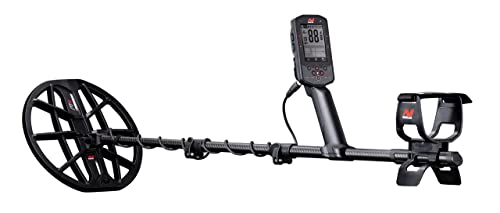
Minelab Manticore
$1,499.00Minelab publishes Multi-IQ+ at 50 percent more power than its traditional models, a 2D target ID map, ten search modes including Beach, and IP68 waterproofing to 16 feet, at $1,499.00.
Best for: an experienced hunter chasing depth on worked beaches
Check price on Amazon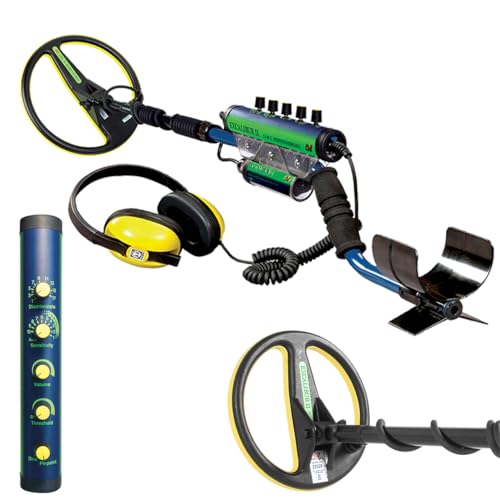
Minelab Excalibur II 1000
$1,699.00BBS multiple frequency technology from 1.5 to 25.5 kHz, a NiMH pack Minelab rates to 12 hours, and an optional side-mount shaft for wading, at $1,699.00. It is built for salt water and depth rather than for convenience.
Best for: surf hunting and diving by people who want nothing else
Check price on Amazon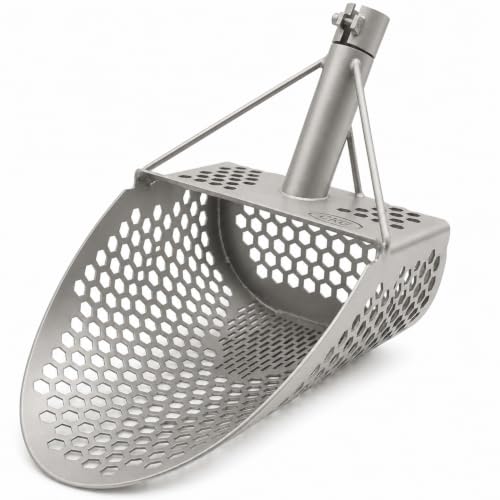
CKG Titanium Sand Scoop
$198.99Titanium does not rust in salt water and does not set off the detector, which is the entire argument for $198.99. If you hunt salt water weekly it outlasts several cheaper scoops.
Best for: serious salt-water beach hunting
Check price on Amazon
RTG Pro Aluminum 47 inch Mini Water Scoop
$122.88RTG publishes a 47 inch aluminium handle welded at 20 degrees so you can put a foot on the back of it, with a 5 by 9 inch bucket, at $122.88. Aluminium keeps it liftable when it is full and under water.
Best for: wading and surf, scooping at arm length
Check price on AmazonWho should not buy this tier: Do not buy this tier to walk dry sand twice a summer. The Minelab Manticore asks you to learn a two-dimensional target display before it repays the money, and if you are going to leave it in Beach mode on factory settings the Minelab Equinox 700 will match it for most of what you do. The Minelab Excalibur II 1000 is a worse choice than anything else here for anyone who hunts dry land as well, because it gives you no usable visual target ID and no modern conveniences. And a titanium scoop is money wasted on a fresh-water hunter, where plain stainless will never corrode in the first place.
How do the beach machines compare on paper?
The column that matters most is the third one. Waterproofing decides how deep you can wade, but frequency approach decides whether the machine can work in the wet strip at all.
Every machine in this table except the Garrett AT Pro is submersible to at least 16 feet as published by its maker, but only the Multi-IQ and Multi-Salt machines are built for the conductive sheet that wet salt sand becomes.
| Machine | Published waterproof rating | Frequency approach | Price | Where it earns its keep |
|---|---|---|---|---|
| Minelab X-Terra Elite | Fully waterproof X-Terra body | Multi-IQ simultaneous multi-frequency | $387.09 | Wet sand and surf on a first budget |
| Minelab Equinox 700 | 16 ft (5 m) | Multi-IQ plus 4 single frequencies | $749.00 | Everything from dry sand to waist deep |
| Minelab Equinox 900 | 16 ft (5 m) | Multi-IQ plus 6 single frequencies | $999.00 | The same, plus Gold mode and the 6 inch coil |
| Minelab Manticore | 16 ft (IP68) | Multi-IQ+ with a 2D target display | $1,499.00 | Depth in wet sand on worked beaches |
| Minelab Excalibur II | Not stated in this listing | BBS, 1.5 to 25.5 kHz | $1,699.00 | Surf and diving specialists |
| Nokta Simplex Ultra | 16 ft (5 m) | Not advertised as simultaneous multi-frequency | $299.00 | Wading, fresh water and damp ground |
| Nokta The Legend | Fully waterproof Pro Pack | Two multi-frequency profiles plus singles | $659.00 | A beach and land machine in one, two coils included |
| Garrett AT Pro | 10 ft | Single frequency | $459.99 | Dry sand and fresh water, not wet salt |
| Garrett Vortex VX9 | 16 ft (5 m) | Singles from 5 to 25 kHz plus multi and Multi-Salt | $599.99 | A Garrett owner who wants a salt mode |
Ratings are as published in each manufacturer listing or manual. Minelab does not state a submersion depth in the Excalibur II listing used here, so check the manual before you take it under. Nothing in this table is a measured result.
Which scoop do you need, and why are they so expensive?
A sand scoop is a sieve on a stick, and the price is almost entirely about the material and the handle length. Salt destroys mild steel, so the useful choices are 304 stainless, aluminium or titanium. The CKG 304 Stainless Sand Scoop at $89.99 is the sensible first purchase. The CKG Titanium Sand Scoop at $198.99 is bought by people who have already worn out a cheaper one, and its real advantage is that titanium does not set the detector off when you sweep over the scoop itself.
Handle length decides your back. RTG publishes a fixed 28 inch handle on the RTG 33 inch Beach Sand Scoop for dry sand and a 47 inch handle on the RTG Pro Aluminum 47 inch Mini Water Scoop for wading, welded at 20 degrees so you can drive it with a foot. If you already own a heavy scoop with a short handle, a CKG Carbon Fiber Sand Scoop Handle at $86.99 is a cheaper fix than replacing the whole thing. The GADFISH Stainless Sand Scoop at $32.99 exists for finding out whether you like beach hunting at all, and it is honestly the right answer for one trip a year, but it is 201 stainless and it will not last like the CKG.
Hole size matters more than people expect. A coarse screen drops small gold chain straight back into the sand. If you are chasing thin jewellery rather than coins, scoop slower and sift over your hand rather than shaking everything out at once. More on carrying what you recover on the finds pouches page.
Where on a beach are the targets, and how do you cover it?
People lose things where they take clothes off, where they throw a ball, and where they get cold. In practice that means the towel line in dry sand, the strip either side of the low-tide line, and any natural funnel such as a set of steps or a gap in a groyne. Heavy weather is what resets a beach, because it strips sand away and exposes layers that have been out of reach for years. That is also when the wet strip is at its widest.
Cover it in lanes, not in loops. A beach is featureless and it is genuinely hard to know what you have already swung over, which is why most people re-walk the same fifty yards three times and never touch the rest. Walk parallel to the water line, overlap each sweep by about half a coil width, and turn around at a marker you can actually see. The search grid planner turns a stretch of beach into a lane count and a walking distance, and the coil coverage tool tells you how long that will take at your sweep speed.
Work the tide, not the clock. The wet strip is only reachable for a few hours either side of low water, so hunt the wet first and move up into dry sand as the water comes back. A bigger coil such as the Minelab EQX 15 Coil (15 inch) makes sense on open sand where separation hardly matters, and the coils page covers when that trade is worth making.
How we chose
We did not test any of this in person. Every specification on this page is taken from the manufacturer listing or manual for that product and attributed where it appears, and where a maker does not publish a figure we say so rather than filling the gap. Picks are chosen on published capability, on the price in this catalog, and on the one question that decides a beach machine: whether its maker says it handles salt.
Sources
- Minelab Equinox 900 product listing and instruction manual
- Minelab Equinox 700 product listing
- Minelab Manticore product listing
- Minelab X-Terra Elite and X-Terra Pro product listings
- Minelab Excalibur II 1000 product listing
- Nokta Simplex Ultra product listing
- CKG, RTG and GADFISH sand scoop product listings
Frequently asked questions
Will a cheap single-frequency detector work at the beach?
In dry sand above the tide line, yes, and quite well. In wet salt sand it will chatter, false and lose depth, and you will end up running the sensitivity so low that you only hear shallow targets. That is the technology rather than the brand. If your budget stops short of a multi-frequency machine, hunt the dry sand deliberately and accept that the wet strip is out of reach for now.
Do I need a fully waterproof machine if I only hunt dry sand?
No, but rain and spray will find you anyway, and a waterproof machine removes a whole category of worry. Note the distinction in the listings carefully: a waterproof searchcoil is not a waterproof detector. Garrett states plainly on the Garrett ACE 200 that the coil can be submerged in shallow water while the control box cannot. Machines rated IP68 to 16 feet are a different proposition entirely.
Is a titanium sand scoop worth the money?
Only if you hunt salt water often. Titanium does not corrode in salt and does not trigger the detector when you sweep across it, which is why the CKG Titanium Sand Scoop costs what it does. For a few trips a year the CKG 304 Stainless Sand Scoop at $89.99 does the same job, and in fresh water plain stainless will never corrode in the first place.
What settings should I start with on wet salt sand?
Start in the Beach mode your manual specifies, ground balance where the machine allows it, then reduce sensitivity one step at a time until the chatter stops rather than starting low and creeping up. Recovery speed usually needs to come up on wet sand as well. Every machine is different, so work from your own manual and write down what worked at which tide state.
Can I use wireless headphones at the beach?
On the sand, yes, and the low-latency sets that ship with machines like the Minelab Equinox 700 are made for it because ordinary Bluetooth delay makes pinpointing by ear impossible. Under water, no. Radio does not carry through water, so a submerged machine needs a wired waterproof set such as the Minelab Equinox Waterproof Headphones or the Thresher Submersible Headphones for Nokta.
Researched, not professional advice. This page is compiled from published specifications, manuals and owner-review consensus, not hands-on testing. Target ID numbers, depth figures and settings vary with soil chemistry, moisture, target size, depth, orientation and firmware version, so treat every figure here as a starting point and verify it against your own machine's manual and your own ground. As an Amazon Associate we earn from qualifying purchases.