Minelab Equinox 900
Equinox 900 Settings by Site Type: Park, Field, Beach, Salt Water, Gold and Relic
Quick answer
Use Park 1 for general park ground, Park 2 or Field 2 for dense trash, Field 1 for open pasture and ploughed land, Beach 1 for dry sand, Beach 2 for wet sand and surf, and Gold 1 or 2 for small gold. Minelab lists four modes with two profiles each on the Equinox 900.
Minelab ships the Minelab Equinox 900 with four detect modes, Park, Field, Beach and Gold, each carrying two preset profiles. Those eight presets are genuinely usable out of the box, which is unusual, and the sensible approach is to start from the right preset and change one thing at a time rather than to build a setup from scratch.
Everything below is a starting point, not a prescription. The right sensitivity on your ground is the highest number that runs quiet, and nobody can tell you what that is from a distance. What a page can do is tell you which preset belongs on which site and which single setting is worth moving first. For the numbers those settings produce, see the Equinox 900 target ID chart.
Top pick
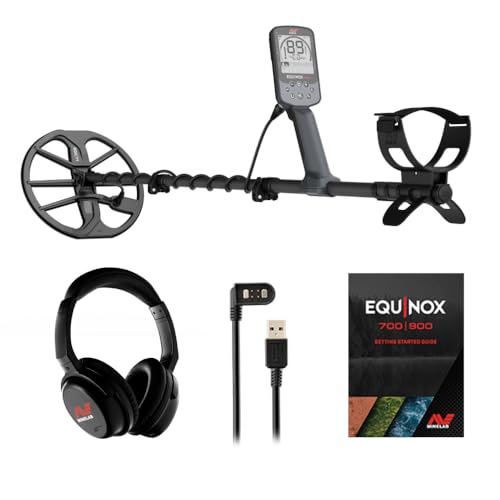
Minelab Equinox 900
Four modes with two profiles each is the whole argument for this machine: one body that is genuinely set up for park, field, beach and gold.
Price was accurate when this page was compiled and changes often.
Which mode belongs on which site?
Start here, then adjust. Sensitivity figures are given as ranges on the Equinox scale of 1 to 25, and the right value is always the highest one that stays quiet on your ground.
Park 1 and Field 1 cover most inland ground, Beach 2 is the wet sand and surf profile, and Gold 1 and 2 are the only modes built around small low-conductive targets.
| Site | Mode | Sensitivity start | Recovery speed | First thing to adjust |
|---|---|---|---|---|
| General park, mixed trash | Park 1 | 18 to 22 | Mid | Drop sensitivity until it runs quiet |
| Dense modern trash, picnic ground | Park 2 | 16 to 20 | High | Raise recovery speed, fit a small coil |
| Open pasture, sports field | Field 1 | 20 to 24 | Low to mid | Raise sensitivity, slow the sweep |
| Ploughed land, iron-heavy old site | Field 2 | 18 to 22 | High | Raise recovery speed, then iron bias |
| Dry beach sand | Beach 1 | 18 to 23 | Mid | Sensitivity, then noise cancel |
| Wet sand and surf | Beach 2 | 16 to 22 | Mid to high | Lower sensitivity until falsing stops |
| In salt water, coil submerged | Beach 2 | 14 to 20 | Mid to high | Sensitivity down, wired waterproof headphones on |
| Goldfield, small nuggets | Gold 1 or 2 | As high as runs stable | Mid | Ground balance, then threshold |
| Relic ground with heavy iron | Field 2 or Park 2 | 16 to 20 | High | Recovery speed and iron bias together |
Starting points only. Minelab presets are the baseline and the manual is the authority for the ranges each setting accepts on your firmware. Change one setting at a time or you will not know what helped.
What does each adjustment actually do?
Four controls do most of the work on this platform. The rest are refinements.
Sensitivity, recovery speed, iron bias and noise cancel account for most of the difference between a machine that finds things and one that chatters.
| Setting | What it changes | Raise it when | Lower it when |
|---|---|---|---|
| Sensitivity | How much signal the machine acts on | Ground is quiet and targets are deep | The machine chatters or falses |
| Recovery speed | How quickly it resets between targets | Trash and iron are dense | Ground is clean and you want maximum depth |
| Iron bias | How readily it calls a mixed signal ferrous | You are digging too many bottle caps | You suspect good targets are being masked |
| Noise cancel | Which channel it transmits on | Interference from power lines or another detector | Never lower, just re-run the automatic scan |
| Ground balance | Compensation for soil mineralisation | Moving to new ground, or after rain | Run the automatic routine rather than guessing |
| Threshold | The background hum you hunt against | Chasing faint deep targets in Gold mode | It masks target audio in noisy ground |
Ranges and increments vary by mode and firmware. The Equinox 700 and 900 manual lists exactly what each setting accepts on your machine, and it is the figure to trust over any chart.
How should you set up for wet salt sand?
Beach 2, sensitivity lower than feels comfortable, and patience. Wet salt sand is conductive, so the machine is fighting a signal that is everywhere and does not go away. Multi-IQ exists precisely for this, which is why the Minelab Equinox 900 handles it and single-frequency machines struggle. Start around 16 to 20 sensitivity, run the automatic noise cancel, and only raise sensitivity once the machine is quiet with the coil on the sand.
If you are taking the machine into the water, remember that wireless audio does not travel through water. Minelab publishes the Minelab Equinox 900 as fully waterproof and submersible to 16 feet, but the included wireless headphones will not work once submerged. The wired Minelab Equinox Waterproof Headphones are the part that makes water hunting possible, and a scoop such as CKG Titanium Sand Scoop is what makes recovery possible in surf.
What changes on relic ground?
Recovery speed first, iron bias second, coil third. Old sites are defined by iron density rather than by depth, so the job is to hear a small non-ferrous target sitting beside a nail. Raise recovery speed so the machine resets between the two, then adjust iron bias downwards if you suspect good targets are being called ferrous, and accept the extra caps that come with it.
The coil is the bigger lever. The Minelab EQX 06 Coil (6 inch) that ships with the 900, or the Coiltek 10 by 5 NOX Search Coil if you want to keep some coverage, will separate targets that the stock Minelab EQX 11 Coil (11 inch) blends together. The coil size chart explains why, and the dig time budget calculator is worth running before a session on ground like this, because recovery time rather than swing time is what limits you.
Sources
- Minelab Equinox 700 and 900 instruction manual
- Minelab Equinox 900 published product specifications
- Minelab Equinox waterproof headphones product listing
Frequently asked questions
What sensitivity should I run on the Equinox 900?
The highest number that runs quiet on the ground in front of you, which on the Equinox scale of 1 to 25 is often somewhere in the high teens to low twenties inland and lower on wet salt sand. Running higher than the ground allows does not buy depth, it buys falsing, and falsing costs you real targets because you stop trusting the machine.
Which mode is best for gold rings on the beach?
Beach 1 on dry sand and Beach 2 on wet sand, rather than Gold mode. Gold mode on the Equinox is built around small nuggets in mineralised goldfield soil, not around jewellery in sand. Rings read in the same band as pull tabs, so the real change is behavioural: leave the low and middle IDs open and accept the trash ratio that comes with hunting them.
Do I need to ground balance the Equinox 900 every time?
Run the automatic routine when you arrive at a site, when you move to noticeably different ground, and after heavy rain. Mineralisation varies within a single field, so a balance taken at the gate may not suit the far corner. It takes seconds and it costs nothing, whereas hunting out of balance costs both depth and stability without announcing itself.
Should I change recovery speed or iron bias first?
Recovery speed. It has the larger and more predictable effect, and it is the setting that decides whether the machine can report on two targets a few inches apart. Move it up on trashy ground and down on clean ground where you want maximum depth. Only once recovery speed is right does adjusting iron bias tell you anything useful.
Can I use the Equinox 900 underwater with the supplied headphones?
No. Minelab publishes the machine as fully waterproof and submersible to 16 feet, and the low latency wireless headphones in the box are not part of that. Wireless audio does not pass through water. Wading with the control box dry is fine on wireless, but anything submerged needs the wired waterproof Equinox headphones instead.
Researched, not professional advice. This page is compiled from published specifications, manuals and owner-review consensus, not hands-on testing. Target ID numbers, depth figures and settings vary with soil chemistry, moisture, target size, depth, orientation and firmware version, so treat every figure here as a starting point and verify it against your own machine's manual and your own ground. As an Amazon Associate we earn from qualifying purchases.